
| 41.3991 0.666 (1.63%) | 08-25 15:22 | |||||||||||||
|
|
| Short term |   |
|||
| Mid term |   |
|||
| Targets | 6-month : | 49.38 | 1-year : | 57.67 |
| Resists | First : | 42.27 | Second : | 49.38 |
| Pivot price | 41.12 | |||
| Supports | First : | 40 | Second : | 38.59 |
| MAs | MA(5) : | 41.15 |
MA(20) : | 40.89 |
| MA(100) : | 41.61 |
MA(250) : | 37.34 |
|
| MACD | MACD : | -0.1 |
Signal : | -0.2 |
| %K %D | K(14,3) : | 37.6 |
D(3) : | 43.2 |
| RSI | RSI(14): 51.3 |
|||
| 52-week | High : | 47.47 | Low : | 30.11 |
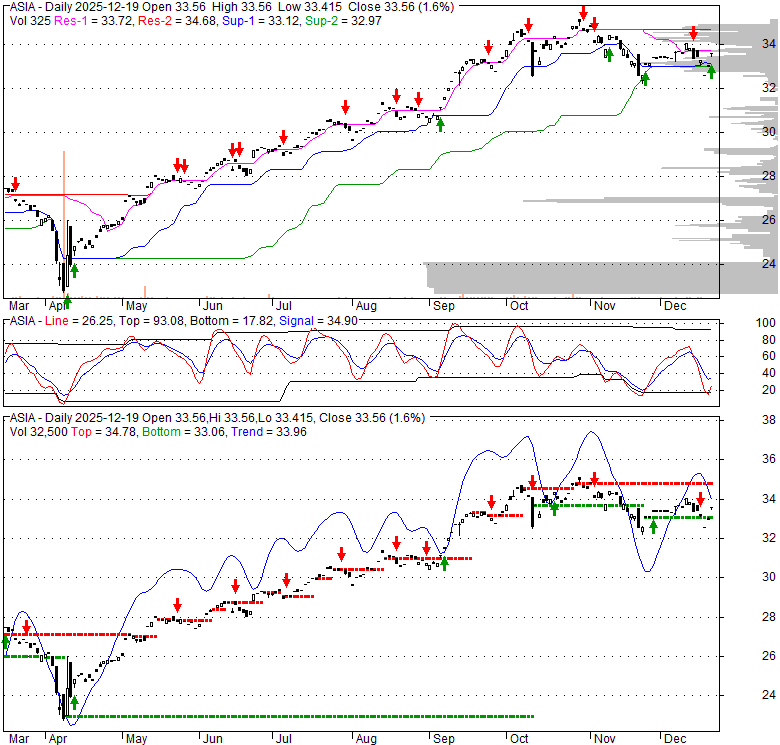
Price has closed above its short-term moving average. Short-term moving average is currently below mid-term; and below long-term moving average. From the relationship between price and moving averages: This stock is NEUTRAL in short-term; and BEARISH in mid-long term.[ ASIA ] has closed below upper band by 32.1%. Bollinger Bands are 71.6% narrower than normal. The narrow width of the bands suggests low volatility as compared to its normal range. The bands have been in this narrow range for 4 bars. This is a sign that the market may be about to initiate a new trend.
| If tomorrow: | Open lower | Open higher |
| High: | 41.45 - 41.61 | 41.61 - 41.75 |
| Low: | 40.79 - 40.99 | 40.99 - 41.17 |
| Close: | 41.02 - 41.35 | 41.35 - 41.64 |
The Matthews Pacific Tiger Active ETF (ASIA) aims to allocate capital to equity securities, including both common and preferred shares, issued by Asian enterprises poised for sustainable long-term expansion. Its geographic scope encompasses the broader Asia Pacific region, specifically excluding Japan, spanning a spectrum of economies from developed nations to rapidly evolving emerging markets and nascent frontier economies. Although the portfolio generally favors mid-to-large capitalization companies, the fund retains flexibility to invest in firms of varying sizes. Selection is informed by a comprehensive assessment of metrics like book value, sales figures, profitability, cash flow generation, dividend distributions, and employee numbers. The investment process is fundamentally driven, emphasizing companies distinguished by strong balance sheets, consistent cash flow, operational adaptability, high integrity, compelling product arrays, shrewd marketing tactics, robust corporate governance, sound financial footing, and experienced leadership. Environmental, Social, and Governance (ESG) factors are also considered as part of the investment analysis. However, it is important to note that not every portfolio holding will necessarily demonstrate strong ESG attributes, and there may be occasions when a comprehensive ESG profile for a company is unavailable or indeterminable. Furthermore, the fund is permitted to invest in various depositary receipts, such as American, European, and Global Depositary Receipts.
Sat, 15 Aug 2026
The Technical Signals Behind (ASIA) That Institutions Follow - Stock Traders Daily
Wed, 05 Aug 2026
Precision Trading with Matthews Pacific Tiger Active Etf (ASIA) Risk Zones - Stock Traders Daily
Thu, 23 Jul 2026
Technical Reactions to ASIA Trends in Macro Strategies - Stock Traders Daily
Thu, 07 May 2026
(ASIA) Risk Channels and Responsive Allocation - Stock Traders Daily
Tue, 17 Feb 2026
Matthews chairman wants to re-embrace firm's boutique identity - Citywire
Tue, 17 Feb 2026
US-Headquartered Matthews Transitions Controlling Equity Ownership - Family Wealth Report
| Price to Book Value: P/BV, a ratio used to compare book value to its current market price, to gauge whether a stock is valued properly. |
Neutral |
| Price to Earnings: PE, the ratio for valuing a company that measures its current share price relative to its earnings per share (EPS). |
Neutral |
| Discounted cash flow: DCF, a valuation method used to estimate the value of an investment based on its expected future cash flows. |
Neutral |
| Return on Assets: ROA, indicates how profitable a company is in relation to its total assets, how efficiently uses assets to generate a profit. |
Neutral |
| Return on Equity: ROE, a measure of financial performance calculated by dividing net income by equity. a gauge of profitability and efficiency. |
Neutral |
| Debt to Equity: evaluate financial leverage, reflects the ability of equity to cover outstanding debts in the event of a business downturn. |
Neutral |
|
Exchange:
AMEX
|
|
|
Sector:
Financial Services
|
|
|
Industry:
Asset Management
|
|
| Shares Out | 0 (M) |
| Shares Float | 0 (M) |
| Held by Insiders | 0 (%) |
| Held by Institutions | 0 (%) |
| Shares Short | 0 (K) |
| Shares Short P.Month | 0 (K) |
| EPS | 0 |
| EPS Est Next Qtrly | 0 |
| EPS Est This Year | 0 |
| EPS Est Next Year | 0 |
| Book Value (p.s.) | 0 |
| Profit Margin | 0 % |
| Operating Margin | 0 % |
| Return on Assets (ttm) | 0 % |
| Return on Equity (ttm) | 0 % |
| Qtrly Rev. Growth | 0 % |
| Gross Profit (p.s.) | 0 |
| Sales Per Share | 0 |
| EBITDA (p.s.) | 0 |
| Qtrly Earnings Growth | 0 % |
| Operating Cash Flow | 0 (M) |
| Levered Free Cash Flow | 0 (M) |
| PE Ratio | 0 |
| PEG Ratio | 0 |
| Price to Book value | 0 |
| Price to Sales | 0 |
| Price to Cash Flow | 0 |
| Dividend | 0 |
| Forward Dividend | 0 |
| Dividend Yield | 0% |
| Dividend Pay Date | Invalid DateTime. |
| Ex-Dividend Date | Invalid DateTime. |

|

|
|

|
|
|
|
|
|