
| 96.3984 0.063 (0.07%) | 11-13 13:40 | |||||||||||||
|
|
| Short term |   |
|||
| Mid term |  |
|||
| Targets | 6-month : | 113.01 | 1-year : | 132 |
| Resists | First : | 96.76 | Second : | 113.01 |
| Pivot price | 96.33 |
|||
| Supports | First : | 96.16 | Second : | 95.8 |
| MAs | MA(5) : | 96.28 |
MA(20) : | 96.38  |
| MA(100) : | 95.43 |
MA(250) : | 93.27 |
|
| MACD | MACD : | 0 |
Signal : | 0 |
| %K %D | K(14,3) : | 54.1 |
D(3) : | 48.1 |
| RSI | RSI(14): 52.7 |
|||
| 52-week | High : | 96.76 | Low : | 88.7 |
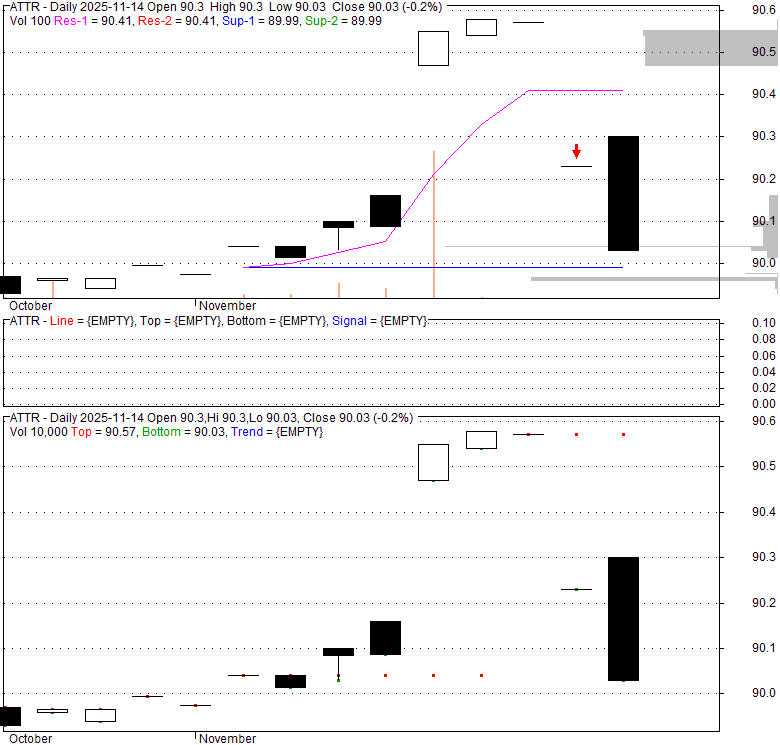
Price has closed above its short-term moving average. Short-term moving average is currently above mid-term; and above long-term moving average. From the relationship between price and moving averages: This stock is BULLISH in short-term; and BULLISH in mid-long term.[ ATTR ] has closed below upper band by 43.1%. Bollinger Bands are 5% narrower than normal. The current width of the bands does not suggest anything about the future direction or movement of prices.
| If tomorrow: | Open lower | Open higher |
| High: | 96.53 - 96.9 | 96.9 - 97.27 |
| Low: | 95.11 - 95.56 | 95.56 - 96.02 |
| Close: | 95.67 - 96.36 | 96.36 - 97.05 |
ATTR seeks to provide exposure to US large-cap equities while aiming to mitigate severe market drawdowns. To do so, the fund employs a four-pronged investment strategy: box spreads, short puts and long call spreads, opportunistic equity exposure, and protective puts. The box spreads aim to earn interest based on collateral with minimal risk. Option spreads aim to generate positive returns or income during bull or flat markets, with capped downside risk. Equity positions begin to be established when the S&P 500 Index declines 15%. The equity exposure increases each time the index declines another 5% until the maximum portfolio allocation is 50% equity. In essence, equity exposure is a systematic buy the dip approach. The protective puts provide an always-on tail-risk hedge and a drag on the portfolio returns. Altogether, the strategy is to provide a balanced approach to offense and defense. Generally, the equity exposure will range between 100% to 40% of the portfolio.
| Price to Book Value: P/BV, a ratio used to compare book value to its current market price, to gauge whether a stock is valued properly. |
Neutral |
| Price to Earnings: PE, the ratio for valuing a company that measures its current share price relative to its earnings per share (EPS). |
Neutral |
| Discounted cash flow: DCF, a valuation method used to estimate the value of an investment based on its expected future cash flows. |
Neutral |
| Return on Assets: ROA, indicates how profitable a company is in relation to its total assets, how efficiently uses assets to generate a profit. |
Neutral |
| Return on Equity: ROE, a measure of financial performance calculated by dividing net income by equity. a gauge of profitability and efficiency. |
Neutral |
| Debt to Equity: evaluate financial leverage, reflects the ability of equity to cover outstanding debts in the event of a business downturn. |
Neutral |
|
Exchange:
CBOE
|
|
|
Sector:
Financial Services
|
|
|
Industry:
Asset Management
|
|
| Shares Out | 0 (M) |
| Shares Float | 0 (M) |
| Held by Insiders | 0 (%) |
| Held by Institutions | 0 (%) |
| Shares Short | 0 (K) |
| Shares Short P.Month | 0 (K) |
| EPS | 0 |
| EPS Est Next Qtrly | 0 |
| EPS Est This Year | 0 |
| EPS Est Next Year | 0 |
| Book Value (p.s.) | 0 |
| Profit Margin | 0 % |
| Operating Margin | 0 % |
| Return on Assets (ttm) | 0 % |
| Return on Equity (ttm) | 0 % |
| Qtrly Rev. Growth | 0 % |
| Gross Profit (p.s.) | 0 |
| Sales Per Share | 0 |
| EBITDA (p.s.) | 0 |
| Qtrly Earnings Growth | 0 % |
| Operating Cash Flow | 0 (M) |
| Levered Free Cash Flow | 0 (M) |
| PE Ratio | 0 |
| PEG Ratio | 0 |
| Price to Book value | 0 |
| Price to Sales | 0 |
| Price to Cash Flow | 0 |
| Dividend | 0 |
| Forward Dividend | 0 |
| Dividend Yield | 0% |
| Dividend Pay Date | Invalid DateTime. |
| Ex-Dividend Date | Invalid DateTime. |

|

|

|

|
|
|
|
|
|