
| 57.529 2.439 (4.43%) | 07-31 16:00 | |||||||||||||
|
|
| Short term |   |
|||
| Mid term |  |
|||
| Targets | 6-month : | 70.56 | 1-year : | 74.4 |
| Resists | First : | 60.41 | Second : | 63.7 |
| Pivot price | 58.2  |
|||
| Supports | First : | 55.09 | Second : | 45.83 |
| MAs | MA(5) : | 56.28 |
MA(20) : | 58.79 |
| MA(100) : | 57.52 |
MA(250) : | 55.32 |
|
| MACD | MACD : | -1.2 |
Signal : | -0.9 |
| %K %D | K(14,3) : | 14.3 |
D(3) : | 5 |
| RSI | RSI(14): 44.9 |
|||
| 52-week | High : | 63.93 | Low : | 49.37 |
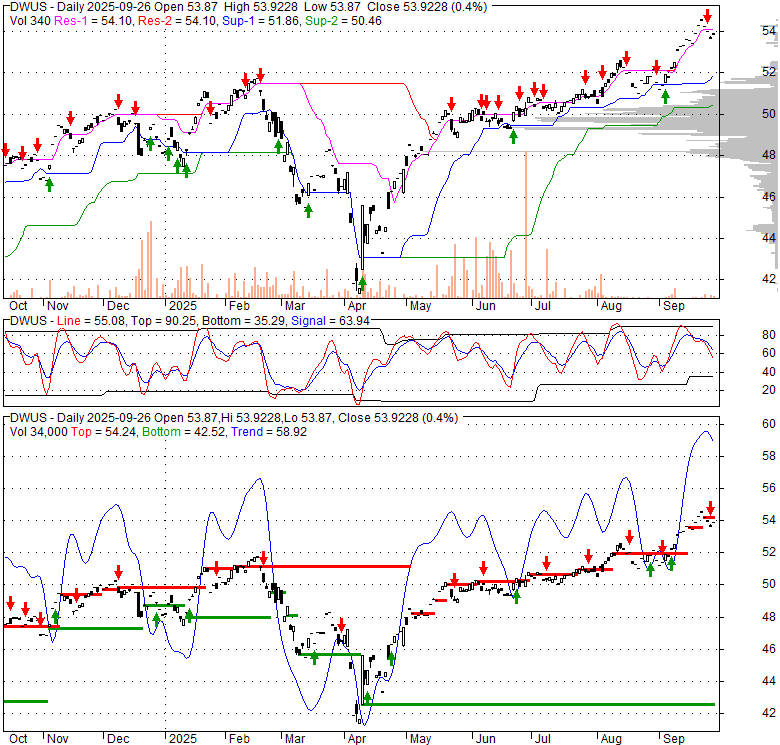
Price has closed above its short-term moving average. Short-term moving average is currently below mid-term; and below long-term moving average. From the relationship between price and moving averages: This stock is NEUTRAL in short-term; and NEUTRAL in mid-long term.[ DWUS ] has closed above bottom band by 39.9%. Bollinger Bands are 41.2% wider than normal. The large width of the bands suggest high volatility as compared to its normal range. The bands have been in this wide range for 2 days. This is a sign that the current trend might continue.
| If tomorrow: | Open lower | Open higher |
| High: | 57.86 - 58.13 | 58.13 - 58.39 |
| Low: | 56.82 - 57.15 | 57.15 - 57.45 |
| Close: | 56.99 - 57.53 | 57.53 - 58.01 |
The AdvisorShares Dorsey Wright FSM U.S. Core ETF (DWUS) aims to achieve alpha, or superior returns, by complementing broad market exposures with a more discerning approach. Unlike typical index funds that inherently include both strong and weak companies, DWUS leverages Dorsey Wright's time-tested trend-following methodology and advanced investment modeling. This process is designed to pinpoint the most robust U.S. large-capitalization equity investments while systematically avoiding those exhibiting underperformance. DWUS distinguishes itself through its proactive, active management. Many exchange-traded funds simply mirror a benchmark index, thereby holding every stock within it, even those with less appealing investment characteristics. In contrast, DWUS's investment strategy involves a consistent and systematic evaluation of the U.S. large-cap equity universe. This rigorous screening dictates which asset classes are strategically included in, or removed from, its highly dynamic and tactical portfolio. Understanding that various investment styles cycle through periods of favor and disfavor, successful domestic core equity management necessitates agile adaptation. Factors such as equal-weighting, market-cap weighting, growth, value, low volatility, and momentum all play a critical role in determining performance. DWUS addresses this by allocating capital to the highest-ranking funds within its investment universe. This approach seeks to capitalize on the growth of U.S. large-cap equity styles demonstrating the strongest relative strength, while strategically sidestepping those that are lagging. A cornerstone of the DWUS strategy is its systematic defense mechanism. The fund operates under the conviction that mitigating significant losses is paramount for capital preservation and contributing to better long-term performance. Consequently, DWUS employs a rules-based framework that allows it to tactically shift a portion of its portfolio into cash or short-term fixed income when a pre-defined defensive indicator is triggered. This temporary defensive stance is engineered to provide a buffer against extreme and potentially severe market downturns.
Wed, 06 May 2026
Daily ETF Flows: TLT Picks Up $153M - Yahoo Finance
Tue, 10 Sep 2024
RSST ETF: Is Returns Stacking Hype Or Alpha? - Seeking Alpha
Thu, 18 Apr 2024
Changes & Actions - ETF.com
Sat, 16 Jul 2022
Stocks with Unusual Volume: How to Find Unusual Volume Stocks in Real Time - MarketBeat
| Price to Book Value: P/BV, a ratio used to compare book value to its current market price, to gauge whether a stock is valued properly. |
Neutral |
| Price to Earnings: PE, the ratio for valuing a company that measures its current share price relative to its earnings per share (EPS). |
Neutral |
| Discounted cash flow: DCF, a valuation method used to estimate the value of an investment based on its expected future cash flows. |
Neutral |
| Return on Assets: ROA, indicates how profitable a company is in relation to its total assets, how efficiently uses assets to generate a profit. |
Neutral |
| Return on Equity: ROE, a measure of financial performance calculated by dividing net income by equity. a gauge of profitability and efficiency. |
Neutral |
| Debt to Equity: evaluate financial leverage, reflects the ability of equity to cover outstanding debts in the event of a business downturn. |
Neutral |
|
Exchange:
NASDAQ
|
|
|
Sector:
Financial Services
|
|
|
Industry:
Asset Management
|
|
| Shares Out | 0 (M) |
| Shares Float | 0 (M) |
| Held by Insiders | 0 (%) |
| Held by Institutions | 0 (%) |
| Shares Short | 0 (K) |
| Shares Short P.Month | 0 (K) |
| EPS | 0 |
| EPS Est Next Qtrly | 0 |
| EPS Est This Year | 0 |
| EPS Est Next Year | 0 |
| Book Value (p.s.) | 0 |
| Profit Margin | 0 % |
| Operating Margin | 0 % |
| Return on Assets (ttm) | 0 % |
| Return on Equity (ttm) | 0 % |
| Qtrly Rev. Growth | 0 % |
| Gross Profit (p.s.) | 0 |
| Sales Per Share | 0 |
| EBITDA (p.s.) | 0 |
| Qtrly Earnings Growth | 0 % |
| Operating Cash Flow | 0 (M) |
| Levered Free Cash Flow | 0 (M) |
| PE Ratio | 0 |
| PEG Ratio | 0 |
| Price to Book value | 0 |
| Price to Sales | 0 |
| Price to Cash Flow | 0 |
| Dividend | 0 |
| Forward Dividend | 0 |
| Dividend Yield | 0% |
| Dividend Pay Date | Invalid DateTime. |
| Ex-Dividend Date | Invalid DateTime. |

|

|
|

|
|
|
|
|
|