
| 131.15 0.4 (0.31%) | 10-09 16:00 | |||||||||||||
|
|
| Short term |  |
|||
| Mid term |  |
|||
| Targets | 6-month : | 154.19  |
1-year : | 156.8 |
| Resists | First : | 132.01 |
Second : | 134.25 |
| Pivot price | 130.38  |
|||
| Supports | First : | 128.39 | Second : | 106.82 |
| MAs | MA(5) : | 130.56 |
MA(20) : | 130.56 |
| MA(100) : | 130.07 |
MA(250) : | 122.5 |
|
| MACD | MACD : | -0.5 |
Signal : | -0.7 |
| %K %D | K(14,3) : | 61.8 |
D(3) : | 56.5 |
| RSI | RSI(14): 51.1 |
|||
| 52-week | High : | 135.54 | Low : | 110.78 |
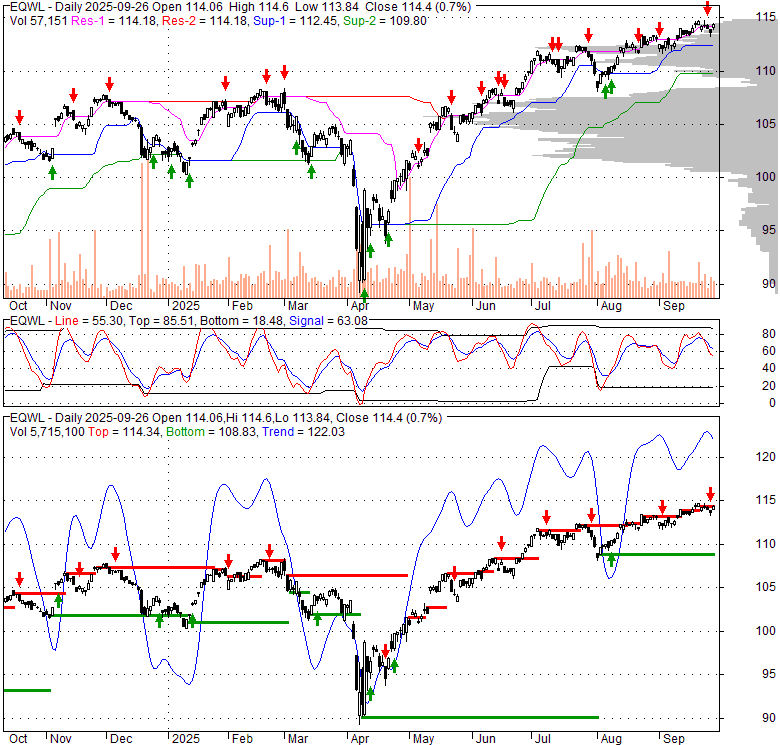
Price has closed above its short-term moving average. Short-term moving average is currently below mid-term; and above long-term moving average. From the relationship between price and moving averages: This stock is NEUTRAL in short-term; and NEUTRAL in mid-long term.[ EQWL ] has closed below upper band by 24.6%. Bollinger Bands are 30.9% narrower than normal. The current width of the bands does not suggest anything about the future direction or movement of prices.
| If tomorrow: | Open lower | Open higher |
| High: | 131.42 - 131.91 | 131.91 - 132.3 |
| Low: | 129.41 - 130.03 | 130.03 - 130.54 |
| Close: | 130.22 - 131.18 | 131.18 - 131.95 |
The Invesco S&P 100 Equal Weight ETF seeks to track the investment results of the S&P 100 Equal Weight Index. This particular index applies an equal-weighting methodology to the constituent companies of the broader S&P 100 Index. The Fund aims to allocate at least 90% of its total assets to the securities comprising this index, with both the Fund and the underlying index undergoing quarterly rebalancing. As of August 31, 2025, the ETF boasted an impressive 5-star overall rating from Morningstar Inc., positioning it among the top 10% of 1077 funds in its category. Its strong performance was also recognized with a 5-star rating for the 3-year period (out of 1077 funds) and the 10-year period (out of 826 funds), alongside a 4-star rating for the 5-year period (out of 1018 funds). Morningstar determines these ratings using a risk-adjusted return measure that emphasizes consistent performance and accounts for monthly performance variations, particularly downward movements. For comparative purposes, open-end mutual funds and exchange-traded funds are assessed together, with a minimum three-year history required for rating eligibility. The overall star rating is a weighted average of the 3-, 5-, and 10-year metrics, where applicable, incorporating fees and expenses but excluding sales charges. It is crucial to remember that past performance offers no guarantee of future returns. Ratings are subject to monthly adjustments and are derived from Morningstar's proprietary data. Had fees not been waived or expenses reimbursed in the past, the Morningstar rating could have been lower. Additionally, ratings for different share classes may vary due to distinct performance characteristics. Morningstar allocates five stars to the top 10% of funds in a category, four stars to the subsequent 22.5%, three stars to the middle 35%, two stars to the following 22.5%, and one star to the bottom 10%.
Sun, 11 Oct 2026
Which Pharmaceuticals ETF Is the Better Buy: iShares’ IHE or Invesco’s PJP? - The Motley Fool
Sun, 11 Oct 2026
Which Healthcare ETF Is the Better Buy: Fidelity’s Broad FHLC or Invesco’s Biotech-Focused PBE? - The Motley Fool
Sat, 10 Oct 2026
Invesco (IVZ) Stock Could Be 39% Undervalued On Excess Returns - Yahoo Finance UK
Sat, 10 Oct 2026
INVESCO EXCHANGE TRADED FD TR S (^RSPM-IV) charts, data and news - Yahoo Finance UK
Fri, 09 Oct 2026
INVESCO EXCHANGE TRADED FD TR S (^RSPM-IV) Charts, Data & News - Yahoo! Finance Canada
Fri, 09 Oct 2026
INVESCO EXCHANGE TRADED FD TR S (^RSPG-IV) components - Yahoo Finance UK
| Price to Book Value: P/BV, a ratio used to compare book value to its current market price, to gauge whether a stock is valued properly. |
Neutral |
| Price to Earnings: PE, the ratio for valuing a company that measures its current share price relative to its earnings per share (EPS). |
Neutral |
| Discounted cash flow: DCF, a valuation method used to estimate the value of an investment based on its expected future cash flows. |
Neutral |
| Return on Assets: ROA, indicates how profitable a company is in relation to its total assets, how efficiently uses assets to generate a profit. |
Neutral |
| Return on Equity: ROE, a measure of financial performance calculated by dividing net income by equity. a gauge of profitability and efficiency. |
Neutral |
| Debt to Equity: evaluate financial leverage, reflects the ability of equity to cover outstanding debts in the event of a business downturn. |
Neutral |
|
Exchange:
AMEX
|
|
|
Sector:
Financial Services
|
|
|
Industry:
Asset Management - Global
|
|
| Shares Out | 0 (M) |
| Shares Float | 0 (M) |
| Held by Insiders | 0 (%) |
| Held by Institutions | 0 (%) |
| Shares Short | 0 (K) |
| Shares Short P.Month | 0 (K) |
| EPS | 0 |
| EPS Est Next Qtrly | 0 |
| EPS Est This Year | 0 |
| EPS Est Next Year | 0 |
| Book Value (p.s.) | 0 |
| Profit Margin | 0 % |
| Operating Margin | 0 % |
| Return on Assets (ttm) | 0 % |
| Return on Equity (ttm) | 0 % |
| Qtrly Rev. Growth | 0 % |
| Gross Profit (p.s.) | 0 |
| Sales Per Share | 0 |
| EBITDA (p.s.) | 0 |
| Qtrly Earnings Growth | 0 % |
| Operating Cash Flow | 0 (M) |
| Levered Free Cash Flow | 0 (M) |
| PE Ratio | 0 |
| PEG Ratio | 0 |
| Price to Book value | 0 |
| Price to Sales | 0 |
| Price to Cash Flow | 0 |
| Dividend | 0 |
| Forward Dividend | 0 |
| Dividend Yield | 0% |
| Dividend Pay Date | Invalid DateTime. |
| Ex-Dividend Date | Invalid DateTime. |

|

|

|

|
|
|
|
|
|