
| 20.08 0.02 (0.1%) | 09-24 13:14 | |||||||||||||
|
|
| Short term |   |
|||
| Mid term | |
|||
| Targets | 6-month : | 23.69 |
1-year : | 23.89 |
| Resists | First : | 20.28 |
Second : | 20.45 |
| Pivot price | 20.34 |
|||
| Supports | First : | 20 |
Second : | 16.63 |
| MAs | MA(5) : | 20.35 |
MA(20) : | 20.31 |
| MA(100) : | 19.81  |
MA(250) : | 19.44 |
|
| MACD | MACD : | 0 |
Signal : | 0.1 |
| %K %D | K(14,3) : | 66 |
D(3) : | 85.3 |
| RSI | RSI(14): 36.4 |
|||
| 52-week | High : | 20.45 | Low : | 18.82 |
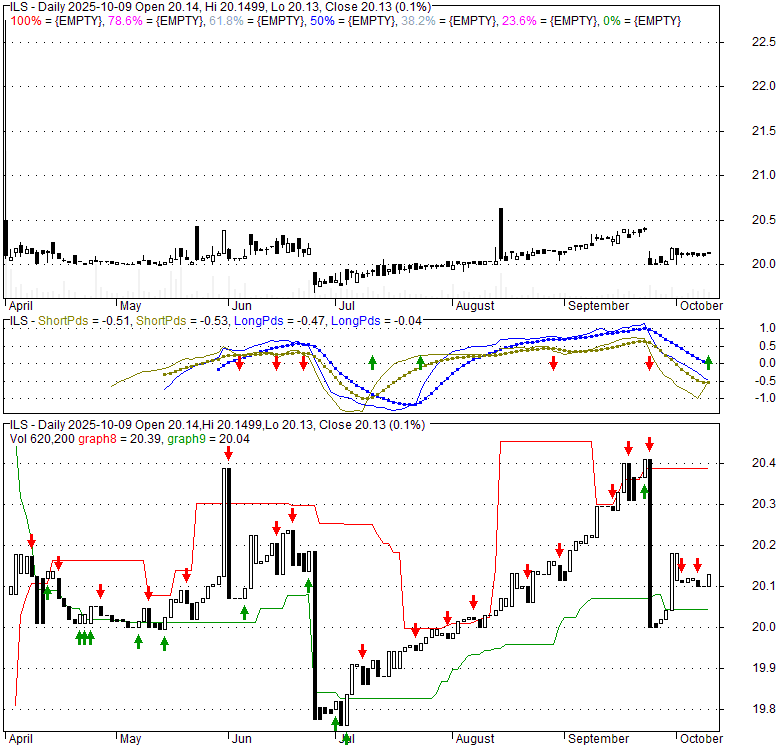
Price has closed below its short-term moving average. Short-term moving average is currently above mid-term; and above long-term moving average. From the relationship between price and moving averages: This stock is NEUTRAL in short-term; and BULLISH in mid-long term.[ ILS ] has closed below the lower bollinger band by 21.9%. Bollinger Bands are 93.8% wider than normal. The large width of the bands suggest high volatility as compared to its normal range. The bands have been in this wide range for 0 days. This is a sign that the current trend might continue.
| If tomorrow: | Open lower | Open higher |
| High: | 20.51 - 20.61 | 20.61 - 20.69 |
| Low: | 20.12 - 20.26 | 20.26 - 20.38 |
| Close: | 20.26 - 20.47 | 20.47 - 20.64 |
ILS is the first US-listed exchange-traded fund (ETF) to focus on catastrophe bonds. It offers investors exposure to a unique asset class, often uncorrelated with traditional markets, through an actively managed and globally diversified portfolio of these bonds. Catastrophe bonds, frequently called Cat bonds, are financial instruments designed to shift the monetary burden of natural disasters from insurance companies to capital market investors. This arrangement provides insurers with crucial additional protection, while offering investors the potential for attractive high-yield returns. The fund exclusively invests in high-yield rated Cat bonds, whose payouts are linked to specific natural disaster "trigger events." These bonds can be issued by a variety of entities, including domestic and international insurers, reinsurers, governments, and special purpose vehicles (SPVs). The fund operates with broad investment flexibility, placing no restrictions on the maturity of its securities, the specific types of natural catastrophes it covers, the geographic regions involved, or the economic or physical loss thresholds for its investments. Investment selection is based on a comprehensive assessment of both qualitative and quantitative factors, such as the nature of the peril, geographical exposure, payout triggers, the issuing entity, and the anticipated risk-adjusted return.
Thu, 24 Sep 2026
ETFs on TXSE: A Big Milestone for Y’all Street - ETF Database
Wed, 26 Aug 2026
Brookmont Catastrophic Bond ETF to Transition from NYSE Arca to Texas Stock Exchange on September 18, 2026 - finance.yahoo.com
Wed, 15 Jul 2026
ILS ETF Profile: Dividends, Returns (BOATS:ILS) - TradingView
Fri, 03 Jul 2026
Most Income Investors Have Never Heard of the Bond ETF Paying 8 Percent for Betting Against Natural Disasters - 24/7 Wall St.
Mon, 01 Jun 2026
ILS: After A Year Of Existence We Are Revisiting This Catastrophe Bond Fund (Rating Downgrade) - Seeking Alpha
Mon, 01 Dec 2025
Brookmont cat bond ETF gains momentum as trading volume rises, assets surpass $25m - Artemis.bm
| Price to Book Value: P/BV, a ratio used to compare book value to its current market price, to gauge whether a stock is valued properly. |
Neutral |
| Price to Earnings: PE, the ratio for valuing a company that measures its current share price relative to its earnings per share (EPS). |
Neutral |
| Discounted cash flow: DCF, a valuation method used to estimate the value of an investment based on its expected future cash flows. |
Neutral |
| Return on Assets: ROA, indicates how profitable a company is in relation to its total assets, how efficiently uses assets to generate a profit. |
Neutral |
| Return on Equity: ROE, a measure of financial performance calculated by dividing net income by equity. a gauge of profitability and efficiency. |
Neutral |
| Debt to Equity: evaluate financial leverage, reflects the ability of equity to cover outstanding debts in the event of a business downturn. |
Neutral |
|
Exchange:
AMEX
|
|
|
Sector:
Financial Services
|
|
|
Industry:
Asset Management - Bonds
|
|
| Shares Out | 0 (M) |
| Shares Float | 0 (M) |
| Held by Insiders | 0 (%) |
| Held by Institutions | 0 (%) |
| Shares Short | 0 (K) |
| Shares Short P.Month | 0 (K) |
| EPS | 0 |
| EPS Est Next Qtrly | 0 |
| EPS Est This Year | 0 |
| EPS Est Next Year | 0 |
| Book Value (p.s.) | 0 |
| Profit Margin | 0 % |
| Operating Margin | 0 % |
| Return on Assets (ttm) | 0 % |
| Return on Equity (ttm) | 0 % |
| Qtrly Rev. Growth | 0 % |
| Gross Profit (p.s.) | 0 |
| Sales Per Share | 0 |
| EBITDA (p.s.) | 0 |
| Qtrly Earnings Growth | 0 % |
| Operating Cash Flow | 0 (M) |
| Levered Free Cash Flow | 0 (M) |
| PE Ratio | 0 |
| PEG Ratio | 0 |
| Price to Book value | 0 |
| Price to Sales | 0 |
| Price to Cash Flow | 0 |
| Dividend | 0 |
| Forward Dividend | 0 |
| Dividend Yield | 0% |
| Dividend Pay Date | Invalid DateTime. |
| Ex-Dividend Date | Invalid DateTime. |

|

|
|

|
|
|
|
|
|