
| 0 (0%) | 09-16 11:21 | |||||||||||||
|
|
| Short term |  |
|||
| Mid term |  |
|||
| Targets | 6-month : | 261.33  |
1-year : | 266.14 |
| Resists | First : | 223.74 |
Second : | 227.86 |
| Pivot price | 221.93 |
|||
| Supports | First : | 217.1 |
Second : | 180.62 |
| MAs | MA(5) : | 219.25 |
MA(20) : | 222.58 |
| MA(100) : | 217.53 |
MA(250) : | 198.38 |
|
| MACD | MACD : | -1.2 |
Signal : | -0.5 |
| %K %D | K(14,3) : | 13.7 |
D(3) : | 13.8 |
| RSI | RSI(14): 36.9 |
|||
| 52-week | High : | 227.86 | Low : | 166.72 |
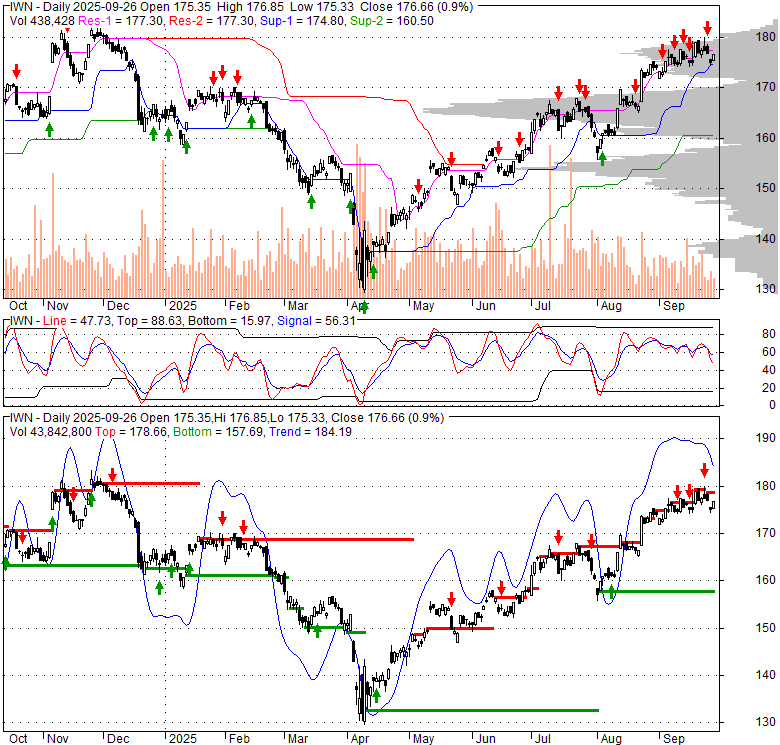
Price has closed below its short-term moving average. Short-term moving average is currently below mid-term; and above long-term moving average. From the relationship between price and moving averages: This stock is BEARISH in short-term; and NEUTRAL in mid-long term.[ IWN ] has closed above bottom band by 3.6%. Bollinger Bands are 3.2% wider than normal. The current width of the bands does not suggest anything about the future direction or movement of prices.
| If tomorrow: | Open lower | Open higher |
| High: | 221.21 - 222.44 | 222.44 - 223.44 |
| Low: | 214.7 - 216.46 | 216.46 - 217.89 |
| Close: | 216.86 - 219.47 | 219.47 - 221.59 |
Tue, 15 Sep 2026
iShares Russell 2000 Value ETF declares quarterly distribution of $0.8846 - TradingView
Wed, 09 Sep 2026
Technical Reactions to IWN Trends in Macro Strategies - Stock Traders Daily
Wed, 12 Aug 2026
VBR vs. IWN: Which Small-Cap Value ETF Is the Better Buy? - Yahoo Finance
Sat, 18 Jul 2026
IWN: This Small-Cap Value ETF Offers Greater Returns With A Low-Risk Factor (NYSEARCA:IWN) - Seeking Alpha
Wed, 08 Jul 2026
Which Small-Cap Value ETF Is the Better Buy: iShares' IWN or State Street's SLYV? - Yahoo Finance
Sun, 05 Jul 2026
(IWN) Movement Within Algorithmic Entry Frameworks - Stock Traders Daily
| Price to Book Value: P/BV, a ratio used to compare book value to its current market price, to gauge whether a stock is valued properly. |
Neutral |
| Price to Earnings: PE, the ratio for valuing a company that measures its current share price relative to its earnings per share (EPS). |
Neutral |
| Discounted cash flow: DCF, a valuation method used to estimate the value of an investment based on its expected future cash flows. |
Neutral |
| Return on Assets: ROA, indicates how profitable a company is in relation to its total assets, how efficiently uses assets to generate a profit. |
Neutral |
| Return on Equity: ROE, a measure of financial performance calculated by dividing net income by equity. a gauge of profitability and efficiency. |
Neutral |
| Debt to Equity: evaluate financial leverage, reflects the ability of equity to cover outstanding debts in the event of a business downturn. |
Neutral |
|
Exchange:
|
|
|
Sector:
|
|
|
Industry:
|
|
| Shares Out | 0 (M) |
| Shares Float | 0 (M) |
| Held by Insiders | 0 (%) |
| Held by Institutions | 0 (%) |
| Shares Short | 0 (K) |
| Shares Short P.Month | 0 (K) |
| EPS | 0 |
| EPS Est Next Qtrly | 0 |
| EPS Est This Year | 0 |
| EPS Est Next Year | 0 |
| Book Value (p.s.) | 0 |
| Profit Margin | 0 % |
| Operating Margin | 0 % |
| Return on Assets (ttm) | 0 % |
| Return on Equity (ttm) | 0 % |
| Qtrly Rev. Growth | 0 % |
| Gross Profit (p.s.) | 0 |
| Sales Per Share | 0 |
| EBITDA (p.s.) | 0 |
| Qtrly Earnings Growth | 0 % |
| Operating Cash Flow | 0 (M) |
| Levered Free Cash Flow | 0 (M) |
| PE Ratio | 0 |
| PEG Ratio | 0 |
| Price to Book value | 0 |
| Price to Sales | 0 |
| Price to Cash Flow | 0 |
| Dividend | 0 |
| Forward Dividend | 0 |
| Dividend Yield | 0% |
| Dividend Pay Date | Invalid DateTime. |
| Ex-Dividend Date | Invalid DateTime. |

|

|
|

|
|
|
|
|
|