
| 24.665 0.041 (0.17%) | 07-28 16:00 | |||||||||||||
|
|
| Short term |   |
|||
| Mid term |  |
|||
| Targets | 6-month : | 28.88 |
1-year : | 33.73 |
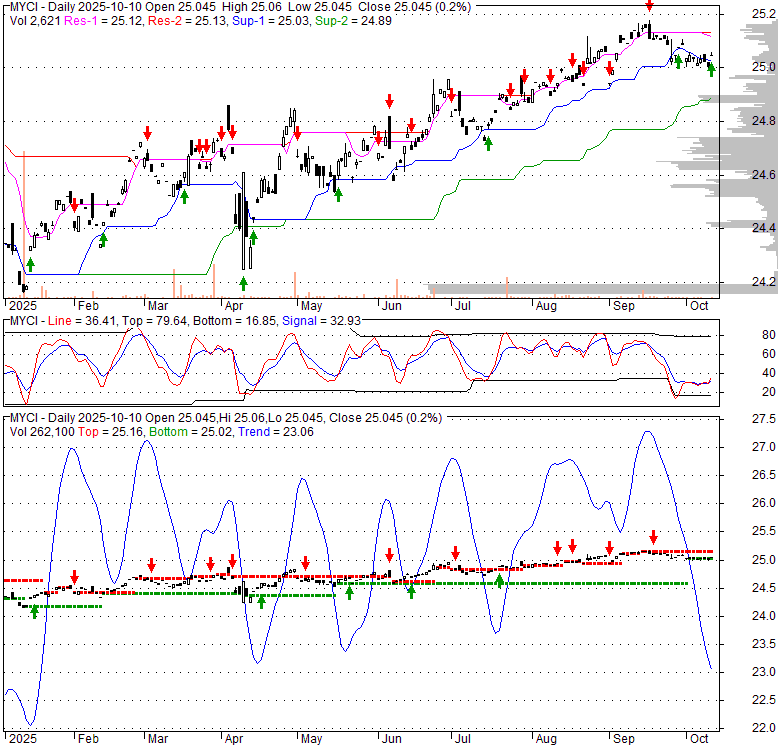
| Resists | First : | 24.72 |
Second : | 28.88 |
| Pivot price | 24.65  |
|||
| Supports | First : | 24.63 |
Second : | 24.57 |
| MAs | MA(5) : | 24.62 |
MA(20) : | 24.66 |
| MA(100) : | 24.59 |
MA(250) : | 24.42 |
|
| MACD | MACD : | -0.1 |
Signal : | 0 |
| %K %D | K(14,3) : | 42 |
D(3) : | 27.6 |
| RSI | RSI(14): 52.5 |
|||
| 52-week | High : | 24.75 | Low : | 23.86 |
Price has closed above its short-term moving average. Short-term moving average is currently below mid-term; and above long-term moving average. From the relationship between price and moving averages: This stock is NEUTRAL in short-term; and NEUTRAL in mid-long term.[ MYCI ] has closed below upper band by 40.2%. Bollinger Bands are 30.8% narrower than normal. The current width of the bands does not suggest anything about the future direction or movement of prices.
| If tomorrow: | Open lower | Open higher |
| High: | 24.71 - 24.88 | 24.88 - 25.02 |
| Low: | 24.31 - 24.5 | 24.5 - 24.64 |
| Close: | 24.42 - 24.71 | 24.71 - 24.93 |
The State Street My2029 Corporate Bond ETF operates with an active management strategy, focusing its investments primarily on corporate bonds scheduled to mature in the year 2029. This fund is structured to liquidate and distribute any remaining principal around December 15, 2029. Its main investment goals are to generate substantial current income while simultaneously safeguarding capital. To achieve these objectives, the fund employs a disciplined, risk-conscious methodology, combining a broad top-down macroeconomic perspective with detailed, bottom-up fundamental analysis for individual security selection. This rigorous research process aims to allocate more capital to the most attractive sectors and issuers within the market. This ETF belongs to the State Street MyIncome family of target maturity funds, offering investors an effective way to construct personalized bond ladder portfolios to better manage interest rate fluctuations, optimize cash flow, and meet specific liquidity requirements.
| Price to Book Value: P/BV, a ratio used to compare book value to its current market price, to gauge whether a stock is valued properly. |
Neutral |
| Price to Earnings: PE, the ratio for valuing a company that measures its current share price relative to its earnings per share (EPS). |
Neutral |
| Discounted cash flow: DCF, a valuation method used to estimate the value of an investment based on its expected future cash flows. |
Neutral |
| Return on Assets: ROA, indicates how profitable a company is in relation to its total assets, how efficiently uses assets to generate a profit. |
Neutral |
| Return on Equity: ROE, a measure of financial performance calculated by dividing net income by equity. a gauge of profitability and efficiency. |
Neutral |
| Debt to Equity: evaluate financial leverage, reflects the ability of equity to cover outstanding debts in the event of a business downturn. |
Neutral |
|
Exchange:
NASDAQ
|
|
|
Sector:
Financial Services
|
|
|
Industry:
Asset Management - Bonds
|
|
| Shares Out | 0 (M) |
| Shares Float | 0 (M) |
| Held by Insiders | 0 (%) |
| Held by Institutions | 0 (%) |
| Shares Short | 0 (K) |
| Shares Short P.Month | 0 (K) |
| EPS | 0 |
| EPS Est Next Qtrly | 0 |
| EPS Est This Year | 0 |
| EPS Est Next Year | 0 |
| Book Value (p.s.) | 0 |
| Profit Margin | 0 % |
| Operating Margin | 0 % |
| Return on Assets (ttm) | 0 % |
| Return on Equity (ttm) | 0 % |
| Qtrly Rev. Growth | 0 % |
| Gross Profit (p.s.) | 0 |
| Sales Per Share | 0 |
| EBITDA (p.s.) | 0 |
| Qtrly Earnings Growth | 0 % |
| Operating Cash Flow | 0 (M) |
| Levered Free Cash Flow | 0 (M) |
| PE Ratio | 0 |
| PEG Ratio | 0 |
| Price to Book value | 0 |
| Price to Sales | 0 |
| Price to Cash Flow | 0 |
| Dividend | 0 |
| Forward Dividend | 0 |
| Dividend Yield | 0% |
| Dividend Pay Date | Invalid DateTime. |
| Ex-Dividend Date | Invalid DateTime. |

|

|
|

|
|
|
|
|
|