
| 17.885 -0.155 (-0.86%) | 09-17 16:00 | |||||||||||||
|
|
| Short term |  |
|||
| Mid term | |
|||
| Targets | 6-month : | 1-year : | ||
| Resists | First : | Second : | ||
| Pivot price | ||||
| Supports | First : | Second : | ||
| MAs | MA(5) : | MA(20) : | ||
| MA(100) : | MA(250) : | |||
| MACD | MACD : | Signal : | ||
| %K %D | K(14,3) : | D(3) : | ||
| RSI | RSI(14): | |||
| 52-week | High : | Low : | ||
| If tomorrow: | Open lower | Open higher |
| High: | - | - |
| Low: | - | - |
| Close: | - | - |
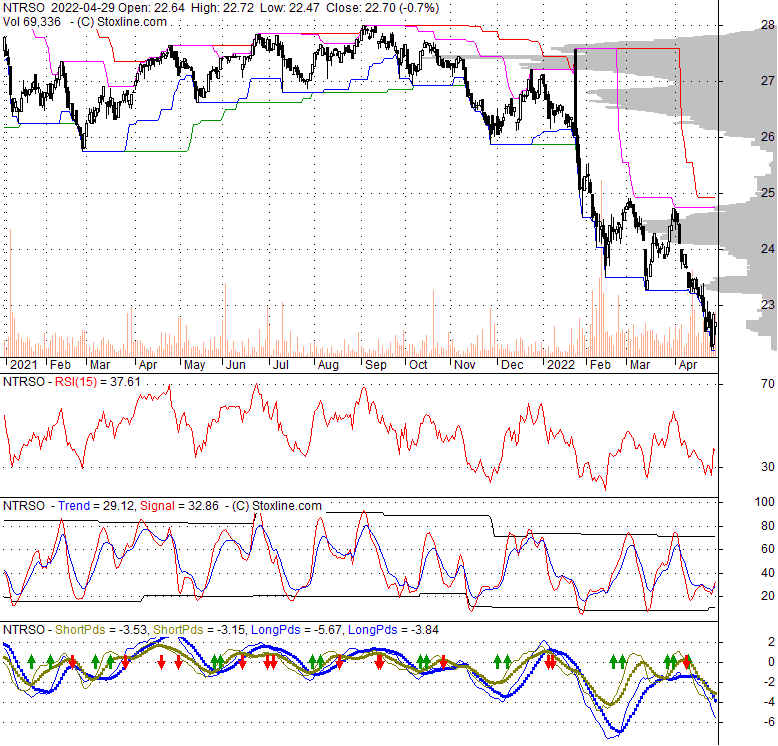
Northern Trust Corporation operates as a diversified financial holding company, offering an extensive suite of wealth management, asset servicing, asset management, and banking solutions to a broad global clientele that includes corporations, institutions, families, and individuals. The company's operations are divided into two main segments: Corporate & Institutional Services (C&IS) and Wealth Management. The C&IS segment specializes in comprehensive asset servicing and related provisions. These encompass custody, fund administration, outsourcing for investment operations, investment management, investment risk and analytical services, employee benefit programs, securities lending, foreign exchange, treasury management, brokerage, transition management, banking, and cash management. This segment primarily serves a diverse array of institutional investors, such as corporate and public retirement funds, foundations, endowments, fund managers, insurance companies, and sovereign wealth funds. The Wealth Management segment caters to affluent clients, delivering services like trust administration, investment management, asset custody, philanthropic guidance, financial consulting, guardianship and estate planning, family business advisory, financial education for families, brokerage services, and private and business banking. Its client base includes high-net-worth individuals and families, business owners, executives, professionals, retirees, and established privately held companies. Beyond these, Northern Trust provides a wide array of asset management capabilities, covering both active and passive equity and fixed income strategies, cash management, and alternative asset classes, specifically private equity and hedge funds of funds. These services are delivered through various structures, including separately managed accounts, bank common and collective funds, registered investment companies, exchange-traded funds, non-U.S. collective investment funds, and unregistered private investment funds, along with multi-manager advisory services and products. The company also offers overlay and other sophisticated risk management solutions. Northern Trust Corporation was established in 1889 and is headquartered in Chicago, Illinois.
Sat, 12 Sep 2026
Trading Systems Reacting to (NTRSO) Volatility - Stock Traders Daily
Mon, 31 Aug 2026
NTRSO Q2 2026 Earnings: Preferred Shares Steady as EPS Surges 7.52% Past Estimates - Quarterly Financial Update - dars.gov.et
Fri, 31 Jul 2026
(NTRSO) Movement as an Input in Quant Signal Sets - Stock Traders Daily
Wed, 22 Jul 2026
Northern Trust Corporation Reports Second Quarter 2026 Financial Results - Yahoo Finance
Thu, 09 Jul 2026
Liquidity Mapping Around (NTRSO) Price Events - Stock Traders Daily
| Price to Book Value: P/BV, a ratio used to compare book value to its current market price, to gauge whether a stock is valued properly. |
Outperform |
| Price to Earnings: PE, the ratio for valuing a company that measures its current share price relative to its earnings per share (EPS). |
Outperform |
| Discounted cash flow: DCF, a valuation method used to estimate the value of an investment based on its expected future cash flows. |
Outperform |
| Return on Assets: ROA, indicates how profitable a company is in relation to its total assets, how efficiently uses assets to generate a profit. |
Neutral |
| Return on Equity: ROE, a measure of financial performance calculated by dividing net income by equity. a gauge of profitability and efficiency. |
Outperform |
| Debt to Equity: evaluate financial leverage, reflects the ability of equity to cover outstanding debts in the event of a business downturn. |
Neutral |
|
Exchange:
NASDAQ
|
|
|
Sector:
Financial Services
|
|
|
Industry:
Asset Management
|
|
| Shares Out | 0 (M) |
| Shares Float | 0 (M) |
| Held by Insiders | (%) |
| Held by Institutions | (%) |
| Shares Short | 0 (K) |
| Shares Short P.Month | 0 (K) |
| EPS | |
| EPS Est Next Qtrly | |
| EPS Est This Year | |
| EPS Est Next Year | |
| Book Value (p.s.) | |
| Profit Margin | % |
| Operating Margin | % |
| Return on Assets (ttm) | % |
| Return on Equity (ttm) | % |
| Qtrly Rev. Growth | % |
| Gross Profit (p.s.) | |
| Sales Per Share | |
| EBITDA (p.s.) | |
| Qtrly Earnings Growth | % |
| Operating Cash Flow | 0 (M) |
| Levered Free Cash Flow | 0 (M) |
| PE Ratio | |
| PEG Ratio | |
| Price to Book value | |
| Price to Sales | |
| Price to Cash Flow |
| Dividend | |
| Forward Dividend | |
| Dividend Yield | 0% |
| Dividend Pay Date | |
| Ex-Dividend Date |

|

|
|

|
|
|
|
|
|