
| 11.79 0.14 (1.2%) | 10-08 16:00 | |||||||||||||
|
|
| Short term |   |
|||
| Mid term |   |
|||
| Targets | 6-month : | 14.47 |
1-year : | 15.11 |
| Resists | First : | 12.39 |
Second : | 12.94 |
| Pivot price | 12.02 |
|||
| Supports | First : | 11.5 | Second : | 9.56 |
| MAs | MA(5) : | 11.77 |
MA(20) : | 12.12 |
| MA(100) : | 11.89 |
MA(250) : | 11.65 |
|
| MACD | MACD : | -0.2 |
Signal : | -0.2 |
| %K %D | K(14,3) : | 12.2 |
D(3) : | 8 |
| RSI | RSI(14): 38 |
|||
| 52-week | High : | 12.98 | Low : | 10.06 |
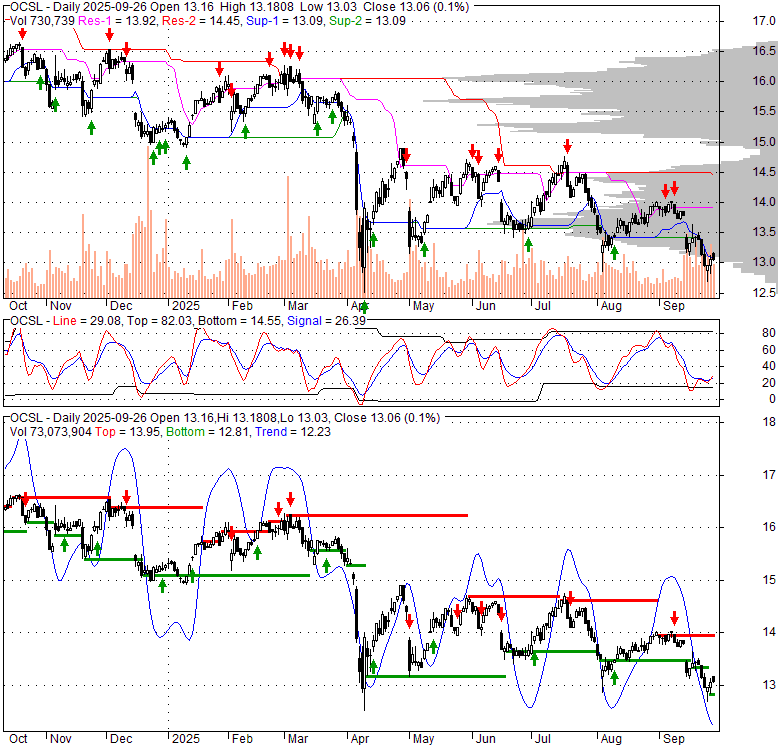
Price has closed above its short-term moving average. Short-term moving average is currently below mid-term; and below long-term moving average. From the relationship between price and moving averages: This stock is NEUTRAL in short-term; and NEUTRAL in mid-long term.[ OCSL ] has closed above bottom band by 25.0%. Bollinger Bands are 9.7% wider than normal. The current width of the bands does not suggest anything about the future direction or movement of prices.
| If tomorrow: | Open lower | Open higher |
| High: | 11.7 - 11.78 | 11.78 - 11.85 |
| Low: | 11.28 - 11.4 | 11.4 - 11.48 |
| Close: | 11.49 - 11.65 | 11.65 - 11.76 |
Oaktree Specialty Lending Corporation (OCSL) functions as a business development company (BDC), dedicated to providing capital solutions for middle-market businesses. Its investment strategy involves a diverse array of financing types, including interim bridge loans, various tiers of secured debt (first and second lien, senior and junior), unsecured loans, hybrid mezzanine debt, and preferred equity stakes. These funds are primarily deployed to support growth initiatives such as corporate expansions, acquisitions led by private equity sponsors, and management buyouts within small and mid-sized enterprises. OCSL actively seeks opportunities across a broad spectrum of industries, including education, general business services, retail and consumer products, healthcare, manufacturing, the food and restaurant sector, construction and engineering, and media and advertising. Individual investments typically range from $5 million to $75 million, predominantly structured as integrated ("one-stop"), first-lien, or second-lien debt facilities, with the potential for a complementary equity co-investment. The target companies generally possess an enterprise value between $20 million and $150 million, and generate operating cash flow (EBITDA) of $3 million to $50 million. While the fund can commit up to $75 million per investment, it has the capacity to originate and underwrite larger transactions, up to $100 million. OCSL primarily concentrates its investment activities within the North American market and aims to serve as the lead investor in its portfolio companies.
Thu, 08 Oct 2026
Wall Street Zen upgraded Oaktree Specialty Lending stock to Hold - AD HOC NEWS
Wed, 07 Oct 2026
Oaktree Specialty Lending Corp. (NASDAQ:OCSL) Stock Has Consensus Target Price of $11.83 - MarketBeat
Sat, 03 Oct 2026
How Oaktree Specialty Lending Corporation (OCSL) Affects Rotational Strategy Timing - Stock Traders Daily
Fri, 02 Oct 2026
Bank of America Corp DE Makes New $1.79 Million Investment in Oaktree Specialty Lending Corp. $OCSL - MarketBeat
Wed, 16 Sep 2026
7% 2031 notes: Oaktree Specialty Lending (OCSL) adds new debt funding - Stock Titan
Wed, 09 Sep 2026
Oaktree Specialty Lending Corporation Prices Public Offering of $300,000,000 7.000% Notes due 2031 - Yahoo Finance
| Price to Book Value: P/BV, a ratio used to compare book value to its current market price, to gauge whether a stock is valued properly. |
Outperform |
| Price to Earnings: PE, the ratio for valuing a company that measures its current share price relative to its earnings per share (EPS). |
Underperform |
| Discounted cash flow: DCF, a valuation method used to estimate the value of an investment based on its expected future cash flows. |
Outperform |
| Return on Assets: ROA, indicates how profitable a company is in relation to its total assets, how efficiently uses assets to generate a profit. |
Outperform |
| Return on Equity: ROE, a measure of financial performance calculated by dividing net income by equity. a gauge of profitability and efficiency. |
Underperform |
| Debt to Equity: evaluate financial leverage, reflects the ability of equity to cover outstanding debts in the event of a business downturn. |
Underperform |
|
Exchange:
NASDAQ
|
|
|
Sector:
Financial Services
|
|
|
Industry:
Asset Management
|
|
| Shares Out | 88 (M) |
| Shares Float | 0 (M) |
| Held by Insiders | 0.3 (%) |
| Held by Institutions | 50.9 (%) |
| Shares Short | 3,030 (K) |
| Shares Short P.Month | 3,670 (K) |
| EPS | 0.47 |
| EPS Est Next Qtrly | 0 |
| EPS Est This Year | 0 |
| EPS Est Next Year | 0 |
| Book Value (p.s.) | 15.69 |
| Profit Margin | 14.4 % |
| Operating Margin | 81.5 % |
| Return on Assets (ttm) | 5.1 % |
| Return on Equity (ttm) | 2.9 % |
| Qtrly Rev. Growth | -7.9 % |
| Gross Profit (p.s.) | 3.31 |
| Sales Per Share | 3.31 |
| EBITDA (p.s.) | 0 |
| Qtrly Earnings Growth | -19.3 % |
| Operating Cash Flow | 106 (M) |
| Levered Free Cash Flow | 89 (M) |
| PE Ratio | 24.56 |
| PEG Ratio | 0.9 |
| Price to Book value | 0.75 |
| Price to Sales | 3.55 |
| Price to Cash Flow | 9.78 |
| Dividend | 0.34 |
| Forward Dividend | 0 |
| Dividend Yield | 2.8% |
| Dividend Pay Date | Invalid DateTime. |
| Ex-Dividend Date | Invalid DateTime. |

|

|

|

|
|
|
|
|
|