
| 71.03 0.02 (0.03%) | 10-08 16:00 | |||||||||||||
|
|
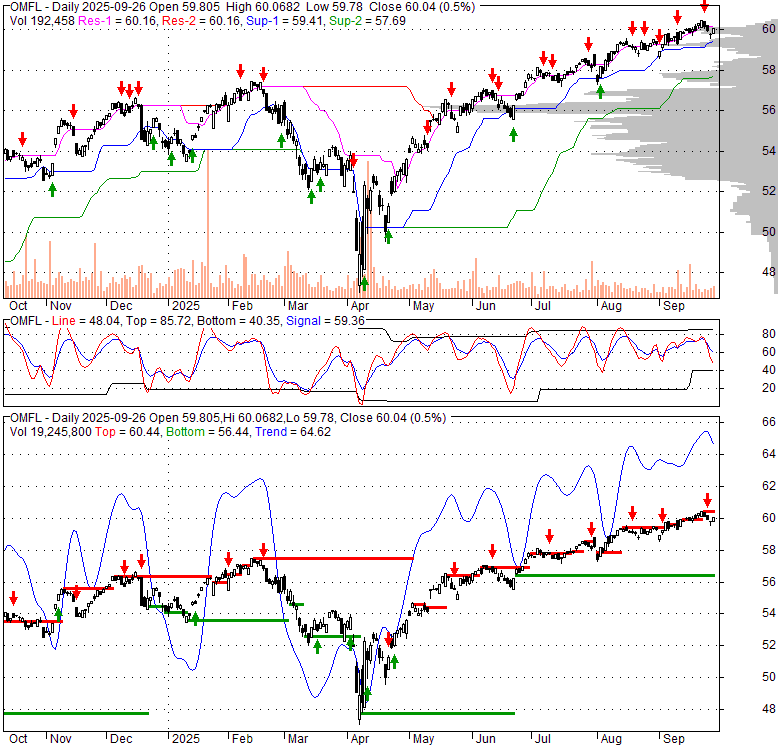
| Short term |  |
|||
| Mid term |   |
|||
| Targets | 6-month : | 83.3 | 1-year : | 97.29 |
| Resists | First : | 71.31 | Second : | 83.3 |
| Pivot price | 70.31 |
|||
| Supports | First : | 69.68 | Second : | 68.67 |
| MAs | MA(5) : | 70.86 |
MA(20) : | 70.09 |
| MA(100) : | 69.19 |
MA(250) : | 64.68 |
|
| MACD | MACD : | 0.2 |
Signal : | 0 |
| %K %D | K(14,3) : | 88.4  |
D(3) : | 90.4 |
| RSI | RSI(14): 60.3 |
|||
| 52-week | High : | 71.37 | Low : | 56.6 |
Price has closed above its short-term moving average. Short-term moving average is currently above mid-term; and above long-term moving average. From the relationship between price and moving averages: This stock is BULLISH in short-term; and BULLISH in mid-long term.[ OMFL ] has closed below upper band by 13.2%. Bollinger Bands are 14.8% narrower than normal. The current width of the bands does not suggest anything about the future direction or movement of prices.
| If tomorrow: | Open lower | Open higher |
| High: | 71.28 - 71.56 | 71.56 - 71.8 |
| Low: | 69.93 - 70.29 | 70.29 - 70.59 |
| Close: | 70.42 - 71 | 71 - 71.49 |
The Invesco Russell 1000 Dynamic Multifactor ETF (OMFL) aims to track the performance of the Russell 1000 Invesco Dynamic Multifactor Index. This exchange-traded fund allocates a minimum of 80% of its total assets to the securities that make up its benchmark index. The Index employs a systematic methodology to adjust the weighting of large-capitalization companies found within the broader Russell 1000 Index. These adjustments are driven by prevailing economic conditions and market cycles, specifically identifying phases of expansion, slowdown, contraction, or recovery. Individual securities receive a composite multi-factor score, based on an assessment across five distinct investment characteristics: value, momentum, quality, low volatility, and size. Both the Fund and its underlying Index are subject to periodic reconstitution and rebalancing, which can occur as frequently as once a month, in response to shifts in economic indicator signals. Please note, this information is for illustrative purposes only and does not constitute a recommendation regarding the appropriateness of any investment strategy for a particular investor. Factor investing, which involves selecting securities based on specific attributes that may influence returns, carries inherent risks; it may underperform traditional market-capitalization-weighted benchmarks and could lead to increased portfolio volatility.
Mon, 05 Oct 2026
Is Invesco Russell 2000 Dynamic Multifactor ETF (OMFS) a Strong ETF Right Now? - Yahoo Finance
Mon, 05 Oct 2026
The Technical Signals Behind (OMFL) That Institutions Follow - Stock Traders Daily
Wed, 30 Sep 2026
OMFL Stock Price, Quote & News - Syfe
Wed, 30 Sep 2026
Should Invesco Russell 1000 Dynamic Multifactor ETF (OMFL) Be on Your Investing Radar? - Yahoo Finance
Fri, 04 Sep 2026
Price-Driven Insight from (OMFL) for Rule-Based Strategy - Stock Traders Daily
Fri, 21 Aug 2026
Is Invesco Russell 1000 Dynamic Multifactor ETF (OMFL) a Strong ETF Right Now? - Yahoo Finance
| Price to Book Value: P/BV, a ratio used to compare book value to its current market price, to gauge whether a stock is valued properly. |
Neutral |
| Price to Earnings: PE, the ratio for valuing a company that measures its current share price relative to its earnings per share (EPS). |
Neutral |
| Discounted cash flow: DCF, a valuation method used to estimate the value of an investment based on its expected future cash flows. |
Neutral |
| Return on Assets: ROA, indicates how profitable a company is in relation to its total assets, how efficiently uses assets to generate a profit. |
Neutral |
| Return on Equity: ROE, a measure of financial performance calculated by dividing net income by equity. a gauge of profitability and efficiency. |
Neutral |
| Debt to Equity: evaluate financial leverage, reflects the ability of equity to cover outstanding debts in the event of a business downturn. |
Neutral |
|
Exchange:
CBOE
|
|
|
Sector:
Financial Services
|
|
|
Industry:
Asset Management - Global
|
|
| Shares Out | 0 (M) |
| Shares Float | 0 (M) |
| Held by Insiders | 0 (%) |
| Held by Institutions | 0 (%) |
| Shares Short | 0 (K) |
| Shares Short P.Month | 0 (K) |
| EPS | 0 |
| EPS Est Next Qtrly | 0 |
| EPS Est This Year | 0 |
| EPS Est Next Year | 0 |
| Book Value (p.s.) | 0 |
| Profit Margin | 0 % |
| Operating Margin | 0 % |
| Return on Assets (ttm) | 0 % |
| Return on Equity (ttm) | 0 % |
| Qtrly Rev. Growth | 0 % |
| Gross Profit (p.s.) | 0 |
| Sales Per Share | 0 |
| EBITDA (p.s.) | 0 |
| Qtrly Earnings Growth | 0 % |
| Operating Cash Flow | 0 (M) |
| Levered Free Cash Flow | 0 (M) |
| PE Ratio | 0 |
| PEG Ratio | 0 |
| Price to Book value | 0 |
| Price to Sales | 0 |
| Price to Cash Flow | 0 |
| Dividend | 0 |
| Forward Dividend | 0 |
| Dividend Yield | 0% |
| Dividend Pay Date | Invalid DateTime. |
| Ex-Dividend Date | Invalid DateTime. |

|

|

|

|
|
|
|
|
|