
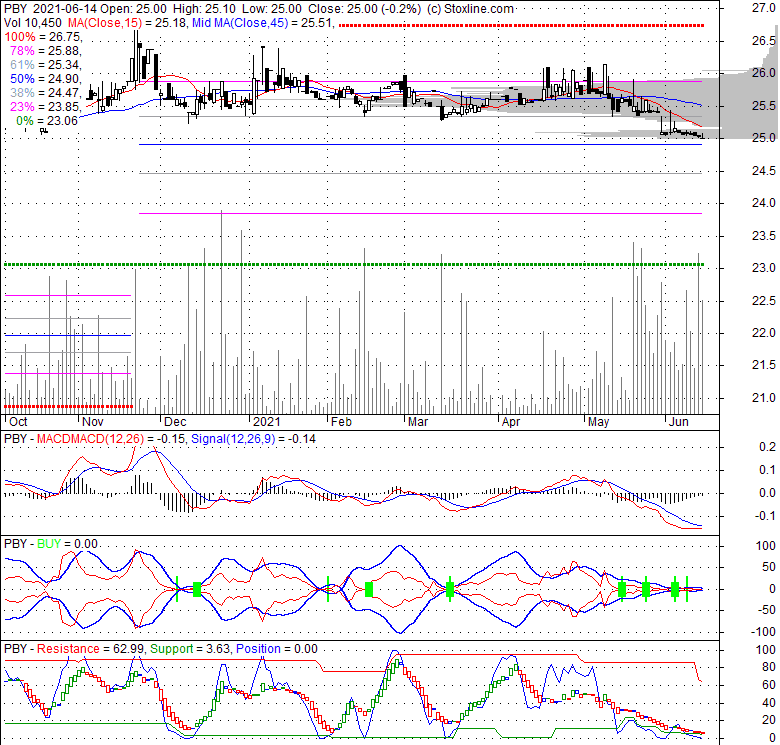
| 25 -0.043 (-0.17%) | 06-14 15:49 | |||||||||||||
|
|
| Short term |  |
|||
| Mid term | |
|||
| Targets | 6-month : | 1-year : | ||
| Resists | First : | Second : | ||
| Pivot price | ||||
| Supports | First : | Second : | ||
| MAs | MA(5) : | MA(20) : | ||
| MA(100) : | MA(250) : | |||
| MACD | MACD : | Signal : | ||
| %K %D | K(14,3) : | D(3) : | ||
| RSI | RSI(14): | |||
| 52-week | High : | Low : | ||
| If tomorrow: | Open lower | Open higher |
| High: | - | - |
| Low: | - | - |
| Close: | - | - |
Prospect Capital Corporation operates as a Business Development Company (BDC), providing a wide array of financing solutions primarily to middle-market businesses. The firm's investment strategy is multifaceted, addressing various company lifecycle stages from emerging growth to mature enterprises. It actively engages in diverse transaction types, including supporting leveraged buyouts (LBOs), corporate acquisitions, refinancings, recapitalizations, and business turnarounds. Capital is also allocated for growth initiatives, development projects, and capital expenditures. Beyond traditional structures, Prospect Capital participates in marketplace lending and bridge financing. It deploys capital through a comprehensive suite of financial instruments, encompassing various forms of debt such as secured debt, senior debt, senior and secured term loans, unitranche facilities, first-lien and second-lien loans, and private debt. The company also provides mezzanine debt and makes direct equity investments. Furthermore, it participates in subordinated debt tranches of collateralized loan obligations (CLOs) and offers cash flow term loans. The company's investment scope extends to both originating new loans and acquiring secondary loan portfolios. It frequently partners with private equity sponsors for debt financings and facilitates dividend recapitalizations. Its core focus is on small and medium-sized private enterprises, including microcap public businesses, intentionally avoiding investments in large public corporations. Additionally, the firm actively invests in real estate, with a particular emphasis on multi-family residential properties. Geographically, its investment mandate primarily covers opportunities within the United States and Canada. While maintaining an industry-agnostic approach, meaning it invests across virtually all sectors, the firm possesses notable expertise in the energy and industrial verticals. Its broad portfolio spans areas such as aerospace & defense, chemicals, financial services, manufacturing, media, technology (including software and IT), healthcare, food & beverage, education, and various consumer, materials, and infrastructure-related industries, including oil & gas, renewables, and utilities. Prospect Capital is flexible in its deal participation, engaging in sole, agented, club, or syndicated transactions. For larger opportunities, it frequently co-invests with other partners. Moreover, it actively pursues control acquisitions, leveraging its ability to provide capital across multiple levels of a company's capital structure. Its investment criteria for target companies typically involve transaction sizes ranging from $10 million to $500 million. It targets businesses generating EBITDA between $5 million and $150 million, with annual sales revenues of $25 million to $500 million, and an enterprise value falling within the $5 million to $1 billion range.
Fri, 05 Jun 2026
Indiana’s Private Equity Power Play - The American Prospect
Thu, 05 Dec 2019
The Role of Public Capital - The American Prospect
| Price to Book Value: P/BV, a ratio used to compare book value to its current market price, to gauge whether a stock is valued properly. |
Neutral |
| Price to Earnings: PE, the ratio for valuing a company that measures its current share price relative to its earnings per share (EPS). |
Neutral |
| Discounted cash flow: DCF, a valuation method used to estimate the value of an investment based on its expected future cash flows. |
Neutral |
| Return on Assets: ROA, indicates how profitable a company is in relation to its total assets, how efficiently uses assets to generate a profit. |
Neutral |
| Return on Equity: ROE, a measure of financial performance calculated by dividing net income by equity. a gauge of profitability and efficiency. |
Neutral |
| Debt to Equity: evaluate financial leverage, reflects the ability of equity to cover outstanding debts in the event of a business downturn. |
Neutral |
|
Exchange:
NYSE
|
|
|
Sector:
Financial Services
|
|
|
Industry:
Asset Management
|
|
| Shares Out | 0 (M) |
| Shares Float | 0 (M) |
| Held by Insiders | (%) |
| Held by Institutions | (%) |
| Shares Short | 0 (K) |
| Shares Short P.Month | 0 (K) |
| EPS | |
| EPS Est Next Qtrly | |
| EPS Est This Year | |
| EPS Est Next Year | |
| Book Value (p.s.) | |
| Profit Margin | % |
| Operating Margin | % |
| Return on Assets (ttm) | % |
| Return on Equity (ttm) | % |
| Qtrly Rev. Growth | % |
| Gross Profit (p.s.) | |
| Sales Per Share | |
| EBITDA (p.s.) | |
| Qtrly Earnings Growth | % |
| Operating Cash Flow | 0 (M) |
| Levered Free Cash Flow | 0 (M) |
| PE Ratio | |
| PEG Ratio | |
| Price to Book value | |
| Price to Sales | |
| Price to Cash Flow |
| Dividend | |
| Forward Dividend | |
| Dividend Yield | 0% |
| Dividend Pay Date | |
| Ex-Dividend Date |

|

|

|

|
|
|
|
|
|