
| 23.29 -0.02 (-0.09%) | 10-23 15:59 | |||||||||||||
|
|
| Short term |  |
|||
| Mid term | |
|||
| Targets | 6-month : | 27.35  |
1-year : | 31.95 |
| Resists | First : | 23.42 |
Second : | 27.35 |
| Pivot price | 23.17 |
|||
| Supports | First : | 23.11 |
Second : | 22.93 |
| MAs | MA(5) : | 23.19 |
MA(20) : | 23.14 |
| MA(100) : | 23.44  |
MA(250) : | 23.48 |
|
| MACD | MACD : | -0.1 |
Signal : | -0.1 |
| %K %D | K(14,3) : | 74.6 |
D(3) : | 66.2 |
| RSI | RSI(14): 55.2 |
|||
| 52-week | High : | 25.64 | Low : | 22.93 |
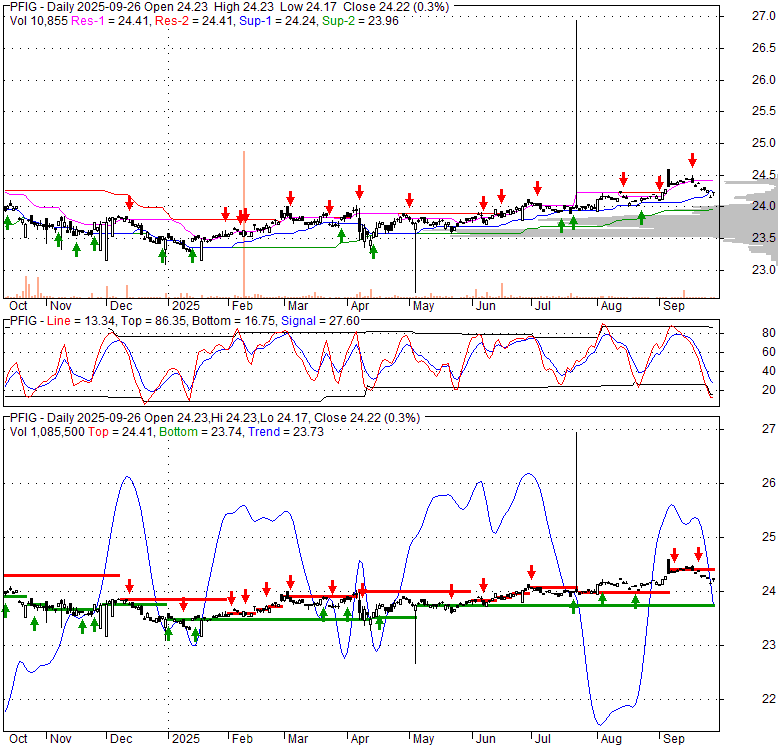
Price has closed above its short-term moving average. Short-term moving average is currently below mid-term; and below long-term moving average. From the relationship between price and moving averages: This stock is NEUTRAL in short-term; and BEARISH in mid-long term.[ PFIG ] has closed below upper band by 10.8%. Bollinger Bands are 17.7% wider than normal. The current width of the bands does not suggest anything about the future direction or movement of prices.
| If tomorrow: | Open lower | Open higher |
| High: | 23.47 - 23.59 | 23.59 - 23.68 |
| Low: | 22.9 - 23.06 | 23.06 - 23.19 |
| Close: | 23.07 - 23.31 | 23.31 - 23.5 |
The Invesco Fundamental Investment Grade Corporate Bond ETF (PFIG) is an exchange-traded fund structured to track the performance of the RAFI Bonds US Investment Grade 1-10 Index. Typically, the Fund allocates at least 80% of its total assets to the securities comprising this benchmark. The underlying index is composed of U.S. dollar-denominated, investment-grade corporate bonds issued by publicly traded American companies. These bonds must qualify under specific SEC registration categories, including SEC-registered, Section 3(a)(2), or Rule 144A securities. For inclusion, bonds must also be non-convertible, non-exchangeable, and possess a fixed, non-zero coupon. The index's methodology, known as the Fundamental Index, was developed by Research Affiliates, LLC, with ALM Research Solutions, LLC responsible for its compilation and calculation. Instead of acquiring every security in the index, the Fund employs a sampling strategy to achieve its investment objectives. Both the Fund and its benchmark index undergo monthly rebalancing and an annual reconstitution, which occurs each March. As of August 31, 2025, Morningstar Inc. awarded the Fund an overall rating of 4 stars out of 163 funds. It also received 4 stars for the 3-year period (out of 163 funds), 4 stars for the 5-year period (out of 148 funds), and 3 stars for the 10-year period (out of 96 funds). Morningstar ratings are based on risk-adjusted returns, emphasizing consistent performance and accounting for variations in monthly performance, particularly downward movements. For comparison, open-end mutual funds and exchange-traded funds are grouped together. To receive a rating, a fund must have at least a three-year history. The overall rating is derived from a weighted average of the 3-, 5-, and 10-year metrics, where applicable, after accounting for fees and expenses but excluding sales charges. Morningstar's star distribution assigns five stars to the top 10% of funds, four stars to the next 22.5%, three stars to the subsequent 35%, two stars to the following 22.5%, and one star to the bottom 10%. These ratings are dynamic and subject to monthly changes. It's important to note that these ratings are proprietary to Morningstar; past performance offers no guarantee of future results. Also, had fees not been waived or expenses reimbursed, the Morningstar rating could have been lower, and ratings may differ for other share classes due to varying performance characteristics.
Fri, 23 Oct 2026
Price-Driven Insight from (PFIG) for Rule-Based Strategy - Stock Traders Daily
Tue, 13 Oct 2026
(PFIG) Movement Within Algorithmic Entry Frameworks - Stock Traders Daily
Tue, 22 Sep 2026
Trading the Move, Not the Narrative: (PFIG) Edition - Stock Traders Daily
Thu, 23 Jul 2026
7 Best ETFs to Invest in Corporate Bonds - U.S. News - Money
Sat, 27 Jun 2026
How Much Of Your Dividend Income Do You Actually Get To Keep? - 24/7 Wall St.
| Price to Book Value: P/BV, a ratio used to compare book value to its current market price, to gauge whether a stock is valued properly. |
Neutral |
| Price to Earnings: PE, the ratio for valuing a company that measures its current share price relative to its earnings per share (EPS). |
Neutral |
| Discounted cash flow: DCF, a valuation method used to estimate the value of an investment based on its expected future cash flows. |
Neutral |
| Return on Assets: ROA, indicates how profitable a company is in relation to its total assets, how efficiently uses assets to generate a profit. |
Neutral |
| Return on Equity: ROE, a measure of financial performance calculated by dividing net income by equity. a gauge of profitability and efficiency. |
Neutral |
| Debt to Equity: evaluate financial leverage, reflects the ability of equity to cover outstanding debts in the event of a business downturn. |
Neutral |
|
Exchange:
AMEX
|
|
|
Sector:
Financial Services
|
|
|
Industry:
Asset Management - Bonds
|
|
| Shares Out | 0 (M) |
| Shares Float | 0 (M) |
| Held by Insiders | 0 (%) |
| Held by Institutions | 0 (%) |
| Shares Short | 0 (K) |
| Shares Short P.Month | 0 (K) |
| EPS | 0 |
| EPS Est Next Qtrly | 0 |
| EPS Est This Year | 0 |
| EPS Est Next Year | 0 |
| Book Value (p.s.) | 0 |
| Profit Margin | 0 % |
| Operating Margin | 0 % |
| Return on Assets (ttm) | 0 % |
| Return on Equity (ttm) | 0 % |
| Qtrly Rev. Growth | 0 % |
| Gross Profit (p.s.) | 0 |
| Sales Per Share | 0 |
| EBITDA (p.s.) | 0 |
| Qtrly Earnings Growth | 0 % |
| Operating Cash Flow | 0 (M) |
| Levered Free Cash Flow | 0 (M) |
| PE Ratio | 0 |
| PEG Ratio | 0 |
| Price to Book value | 0 |
| Price to Sales | 0 |
| Price to Cash Flow | 0 |
| Dividend | 0 |
| Forward Dividend | 0 |
| Dividend Yield | 0% |
| Dividend Pay Date | Invalid DateTime. |
| Ex-Dividend Date | Invalid DateTime. |

|

|

|

|
|
|
|
|
|