
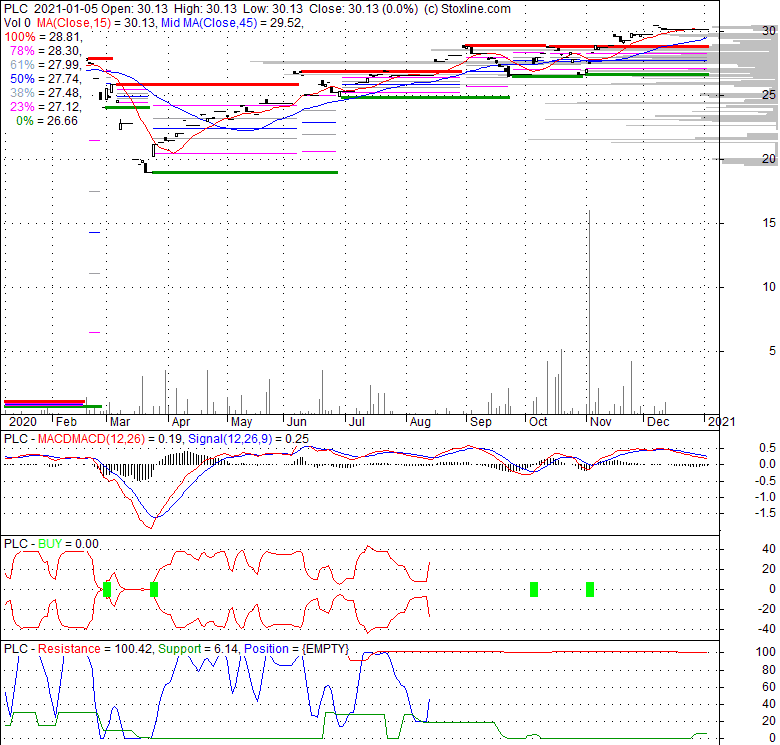
| 30.13 -0.09 (-0.3%) | 12-11 14:33 | |||||||||||||
|
|
| Short term |  |
|||
| Mid term | |
|||
| Targets | 6-month : | 1-year : | ||
| Resists | First : | Second : | ||
| Pivot price | ||||
| Supports | First : | Second : | ||
| MAs | MA(5) : | MA(20) : | ||
| MA(100) : | MA(250) : | |||
| MACD | MACD : | Signal : | ||
| %K %D | K(14,3) : | D(3) : | ||
| RSI | RSI(14): | |||
| 52-week | High : | Low : | ||
| If tomorrow: | Open lower | Open higher |
| High: | - | - |
| Low: | - | - |
| Close: | - | - |
This ETF's primary objective is to closely replicate the performance of the Nasdaq US Large Cap Select Leaders Core Index, prior to accounting for its operational expenses. Under normal market conditions, the fund will allocate at least 80% of its total assets, including any capital acquired through borrowing for investment purposes, to shares of large-capitalization U.S. companies that comprise the index when purchased. The index itself utilizes a sophisticated quantitative framework to pinpoint stocks from the broader Nasdaq US Large Cap Index that demonstrate robust potential across key attributes such as value, quality growth, and strong momentum.
Mon, 12 Oct 2026
Virginia Foxx Stock Trades and Disclosures - TechGraph
Mon, 12 Oct 2026
Julie Johnson Stock Trades and Disclosures - TechGraph
Fri, 02 Oct 2026
The 10 Best Performing ETFs Over the Last 10 Years - YCharts
Fri, 26 Sep 2025
ETFs Investing in 10x Genomics Inc Class A Stocks - TradingView
Wed, 24 Sep 2025
ETFs Investing in ICON Plc Stocks - TradingView
Tue, 23 Sep 2025
ETFs Investing in IMAX Corporation Stocks - TradingView
| Price to Book Value: P/BV, a ratio used to compare book value to its current market price, to gauge whether a stock is valued properly. |
Neutral |
| Price to Earnings: PE, the ratio for valuing a company that measures its current share price relative to its earnings per share (EPS). |
Neutral |
| Discounted cash flow: DCF, a valuation method used to estimate the value of an investment based on its expected future cash flows. |
Neutral |
| Return on Assets: ROA, indicates how profitable a company is in relation to its total assets, how efficiently uses assets to generate a profit. |
Neutral |
| Return on Equity: ROE, a measure of financial performance calculated by dividing net income by equity. a gauge of profitability and efficiency. |
Neutral |
| Debt to Equity: evaluate financial leverage, reflects the ability of equity to cover outstanding debts in the event of a business downturn. |
Neutral |
|
Exchange:
NASDAQ
|
|
|
Sector:
Financial Services
|
|
|
Industry:
Asset Management
|
|
| Shares Out | 0 (M) |
| Shares Float | 0 (M) |
| Held by Insiders | (%) |
| Held by Institutions | (%) |
| Shares Short | 0 (K) |
| Shares Short P.Month | 0 (K) |
| EPS | |
| EPS Est Next Qtrly | |
| EPS Est This Year | |
| EPS Est Next Year | |
| Book Value (p.s.) | |
| Profit Margin | % |
| Operating Margin | % |
| Return on Assets (ttm) | % |
| Return on Equity (ttm) | % |
| Qtrly Rev. Growth | % |
| Gross Profit (p.s.) | |
| Sales Per Share | |
| EBITDA (p.s.) | |
| Qtrly Earnings Growth | % |
| Operating Cash Flow | 0 (M) |
| Levered Free Cash Flow | 0 (M) |
| PE Ratio | |
| PEG Ratio | |
| Price to Book value | |
| Price to Sales | |
| Price to Cash Flow |
| Dividend | |
| Forward Dividend | |
| Dividend Yield | 0% |
| Dividend Pay Date | |
| Ex-Dividend Date |

|

|

|

|
|
|
|
|
|