
| 24.05 -0.009 (-0.04%) | 10-15 15:51 | |||||||||||||
|
|
| Short term |  |
|||
| Mid term |   |
|||
| Targets | 6-month : | 28.16 | 1-year : | 28.25 |
| Resists | First : | 24.11 | Second : | 24.19 |
| Pivot price | 24.08 |
|||
| Supports | First : | 24 | Second : | 19.96 |
| MAs | MA(5) : | 24.08 |
MA(20) : | 24.08  |
| MA(100) : | 24.13 |
MA(250) : | 23.94 |
|
| MACD | MACD : | -0.1 |
Signal : | -0.1 |
| %K %D | K(14,3) : | 40.3 |
D(3) : | 50.8 |
| RSI | RSI(14): 45.5 |
|||
| 52-week | High : | 24.47 | Low : | 23.51 |
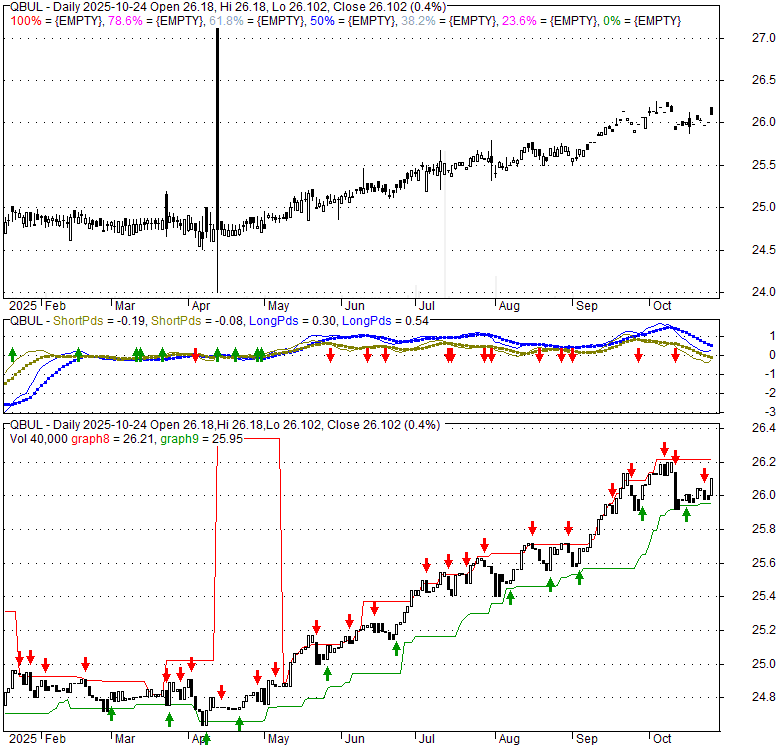
Price has closed below its short-term moving average. Short-term moving average is currently below mid-term; and below long-term moving average. From the relationship between price and moving averages: This stock is BEARISH in short-term; and BEARISH in mid-long term.[ QBUL ] has closed above bottom band by 22.8%. Bollinger Bands are 50.3% narrower than normal. The narrow width of the bands suggests low volatility as compared to its normal range. The bands have been in this narrow range for 29 bars. This is a sign that the market may be about to initiate a new trend.
| If tomorrow: | Open lower | Open higher |
| High: | 24.14 - 24.25 | 24.25 - 24.36 |
| Low: | 23.7 - 23.83 | 23.83 - 23.96 |
| Close: | 23.83 - 24.04 | 24.04 - 24.24 |
QBUL seeks to benefit from tail risk or declines in the US large-cap equity market. The actively managed fund aims for protection during high volatility environments while maintaining potential for income. The fund aims to select high-quality short-term debt securities with about three months to maturity. It then mitigates equity risk and have growth through the utilization of call options. At the start of each quarter, the fund purchases out-of-the money or at-the-money call options. The adviser evaluates the relative prices of options and selects those with the highest expected return based on market volatility. The adviser expects to capture 20- 40% of US large-cap equity market gains on a quarterly basis. The fund may employ more complex option strategies such as box spreads. Income and actual principal value protected are expected to be at least 98% on a quarter-to-quarter basis.
| Price to Book Value: P/BV, a ratio used to compare book value to its current market price, to gauge whether a stock is valued properly. |
Neutral |
| Price to Earnings: PE, the ratio for valuing a company that measures its current share price relative to its earnings per share (EPS). |
Neutral |
| Discounted cash flow: DCF, a valuation method used to estimate the value of an investment based on its expected future cash flows. |
Neutral |
| Return on Assets: ROA, indicates how profitable a company is in relation to its total assets, how efficiently uses assets to generate a profit. |
Neutral |
| Return on Equity: ROE, a measure of financial performance calculated by dividing net income by equity. a gauge of profitability and efficiency. |
Neutral |
| Debt to Equity: evaluate financial leverage, reflects the ability of equity to cover outstanding debts in the event of a business downturn. |
Neutral |
|
Exchange:
CBOE
|
|
|
Sector:
Financial Services
|
|
|
Industry:
Asset Management
|
|
| Shares Out | 0 (M) |
| Shares Float | 0 (M) |
| Held by Insiders | 0 (%) |
| Held by Institutions | 0 (%) |
| Shares Short | 0 (K) |
| Shares Short P.Month | 0 (K) |
| EPS | 0 |
| EPS Est Next Qtrly | 0 |
| EPS Est This Year | 0 |
| EPS Est Next Year | 0 |
| Book Value (p.s.) | 0 |
| Profit Margin | 0 % |
| Operating Margin | 0 % |
| Return on Assets (ttm) | 0 % |
| Return on Equity (ttm) | 0 % |
| Qtrly Rev. Growth | 0 % |
| Gross Profit (p.s.) | 0 |
| Sales Per Share | 0 |
| EBITDA (p.s.) | 0 |
| Qtrly Earnings Growth | 0 % |
| Operating Cash Flow | 0 (M) |
| Levered Free Cash Flow | 0 (M) |
| PE Ratio | 0 |
| PEG Ratio | 0 |
| Price to Book value | 0 |
| Price to Sales | 0 |
| Price to Cash Flow | 0 |
| Dividend | 0 |
| Forward Dividend | 0 |
| Dividend Yield | 0% |
| Dividend Pay Date | Invalid DateTime. |
| Ex-Dividend Date | Invalid DateTime. |

|

|

|

|
|
|
|
|
|