
| 25 -0.07 (-0.28%) | 10-13 15:40 | |||||||||||||
|
|
| Short term |   |
|||
| Mid term | |
|||
| Targets | 6-month : | 29.25 |
1-year : | 29.36 |
| Resists | First : | 25.05 |
Second : | 25.14 |
| Pivot price | 25.03 |
|||
| Supports | First : | 24.89 |
Second : | 20.71 |
| MAs | MA(5) : | 25.05 |
MA(20) : | 25.02  |
| MA(100) : | 24.76 |
MA(250) : | 24.35 |
|
| MACD | MACD : | 0 |
Signal : | 0 |
| %K %D | K(14,3) : | 49.5 |
D(3) : | 56.7 |
| RSI | RSI(14): 51.5 |
|||
| 52-week | High : | 25.14 | Low : | 23.69 |
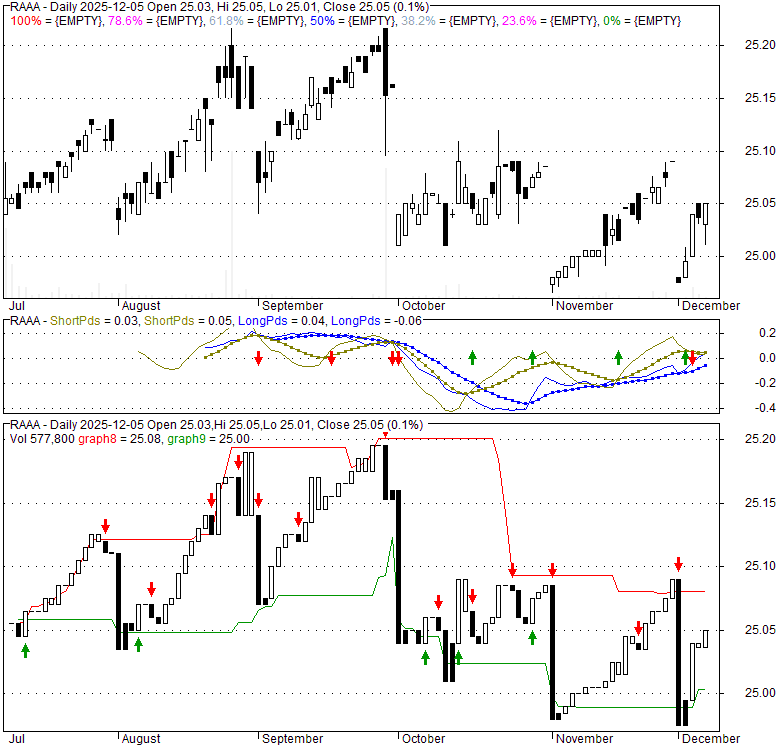
Price has closed below its short-term moving average. Short-term moving average is currently above mid-term; and above long-term moving average. From the relationship between price and moving averages: This stock is NEUTRAL in short-term; and BULLISH in mid-long term.[ RAAA ] has closed above bottom band by 17.1%. Bollinger Bands are 2.3% wider than normal. The current width of the bands does not suggest anything about the future direction or movement of prices.
| If tomorrow: | Open lower | Open higher |
| High: | 25.09 - 25.25 | 25.25 - 25.39 |
| Low: | 24.67 - 24.84 | 24.84 - 24.98 |
| Close: | 24.76 - 25.03 | 25.03 - 25.25 |
The RAAA fund employs a leverage strategy, utilizing reverse repurchase agreements to achieve up to 50% additional exposure to U.S. dollar-denominated Collateralized Loan Obligations (CLOs). Its primary objectives are generating income and preserving capital, which it pursues by concentrating investments in AAA-rated CLO tranches. These tranches represent the most senior and highest-quality segments within a CLO structure, supported by diverse pools of underlying loans, often including leveraged loans. All eligible CLOs must carry an AAA rating or be determined to be of equivalent credit quality by the investment adviser. However, the fund has the flexibility to allocate a maximum of 20% of its assets to CLOs rated AA or A. The investment selection process follows a rigorous bottom-up methodology, assessing factors such as the expertise of the CLO manager, the specifics of the deal structure, the quality of the underlying collateral, projected cash flows, and market trading frequency. A particular emphasis is placed on identifying larger and more liquid transactions. The portfolio may also incorporate Exchange Traded Funds (ETFs) that align with similar investment objectives. The majority of the fund's holdings feature floating interest rates and are acquired from both initial issuance (primary) and existing market (secondary) sources. Allocation adjustments are made dynamically in response to prevailing market trends. Although classified as non-diversified, the fund mitigates concentration risk by capping investments in any individual CLO or CLO manager at 20% of its assets. This approach supports its twin goals of generating income and maintaining high credit quality.
Fri, 09 Oct 2026
RAAA Interactive Stock Chart | Reckoner Yield Enhanced AAA CLO Stock - Yahoo Finance
Tue, 15 Sep 2026
Unlock CLO Arbitrage With Reckoner Capital’s Active Strategy - ETF Database
Fri, 28 Aug 2026
Why CLOs Offer More Stable Yield Potential Than Corporate Credit - ETF Trends
Wed, 29 Jul 2026
Beyond Money Markets: Unlock Premium Yields With CLO ETFs - ETF Trends
Mon, 27 Jul 2026
Reckoner CEO Explains the Need for Actively Managed CLO ETFs - ETF Database
Fri, 24 Jul 2026
Reckoner Offers Tax-Efficient CLO ETFs With RAAR & RCLR - ETF Database
| Price to Book Value: P/BV, a ratio used to compare book value to its current market price, to gauge whether a stock is valued properly. |
Neutral |
| Price to Earnings: PE, the ratio for valuing a company that measures its current share price relative to its earnings per share (EPS). |
Neutral |
| Discounted cash flow: DCF, a valuation method used to estimate the value of an investment based on its expected future cash flows. |
Neutral |
| Return on Assets: ROA, indicates how profitable a company is in relation to its total assets, how efficiently uses assets to generate a profit. |
Neutral |
| Return on Equity: ROE, a measure of financial performance calculated by dividing net income by equity. a gauge of profitability and efficiency. |
Neutral |
| Debt to Equity: evaluate financial leverage, reflects the ability of equity to cover outstanding debts in the event of a business downturn. |
Neutral |
|
Exchange:
AMEX
|
|
|
Sector:
Financial Services
|
|
|
Industry:
Asset Management - Bonds
|
|
| Shares Out | 0 (M) |
| Shares Float | 0 (M) |
| Held by Insiders | 0 (%) |
| Held by Institutions | 0 (%) |
| Shares Short | 0 (K) |
| Shares Short P.Month | 0 (K) |
| EPS | 0 |
| EPS Est Next Qtrly | 0 |
| EPS Est This Year | 0 |
| EPS Est Next Year | 0 |
| Book Value (p.s.) | 0 |
| Profit Margin | 0 % |
| Operating Margin | 0 % |
| Return on Assets (ttm) | 0 % |
| Return on Equity (ttm) | 0 % |
| Qtrly Rev. Growth | 0 % |
| Gross Profit (p.s.) | 0 |
| Sales Per Share | 0 |
| EBITDA (p.s.) | 0 |
| Qtrly Earnings Growth | 0 % |
| Operating Cash Flow | 0 (M) |
| Levered Free Cash Flow | 0 (M) |
| PE Ratio | 0 |
| PEG Ratio | 0 |
| Price to Book value | 0 |
| Price to Sales | 0 |
| Price to Cash Flow | 0 |
| Dividend | 0 |
| Forward Dividend | 0 |
| Dividend Yield | 0% |
| Dividend Pay Date | Invalid DateTime. |
| Ex-Dividend Date | Invalid DateTime. |

|

|

|

|
|
|
|
|
|