
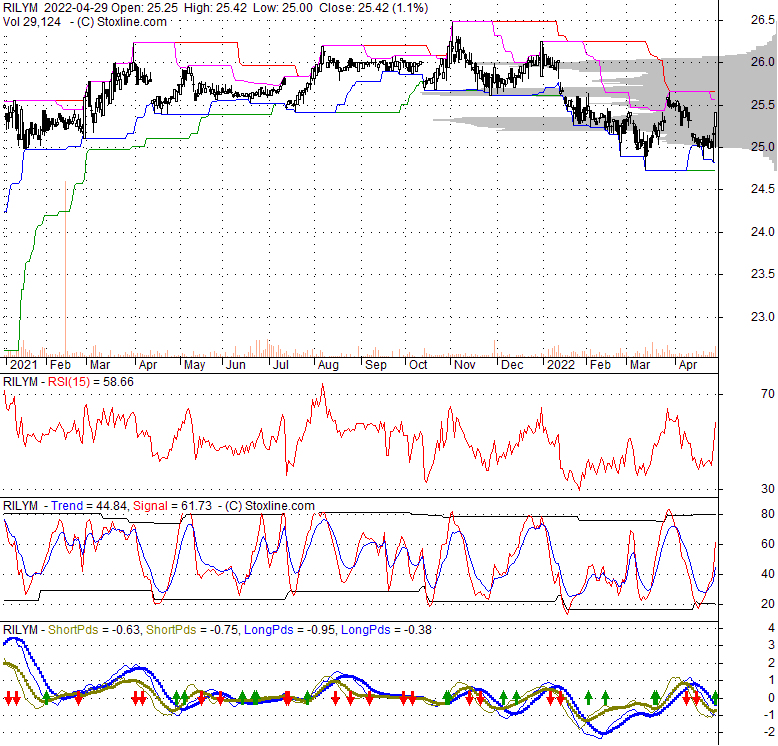
| 25.11 0 (0%) | 02-27 16:00 | |||||||||||||
|
|
| Short term |  |
|||
| Mid term | |
|||
| Targets | 6-month : | 1-year : | ||
| Resists | First : | Second : | ||
| Pivot price | ||||
| Supports | First : | Second : | ||
| MAs | MA(5) : | MA(20) : | ||
| MA(100) : | MA(250) : | |||
| MACD | MACD : | Signal : | ||
| %K %D | K(14,3) : | D(3) : | ||
| RSI | RSI(14): | |||
| 52-week | High : | Low : | ||
| If tomorrow: | Open lower | Open higher |
| High: | - | - |
| Low: | - | - |
| Close: | - | - |
B. Riley Financial, Inc. offers a comprehensive array of financial services and tailored solutions, addressing the capital acquisition and financial advisory requirements of both public and private enterprises. The company structures its operations across six primary divisions: Capital Markets, Wealth Management, Financial Consulting, Auction and Liquidation, Communications, and Consumer. The Capital Markets segment delivers expertise in investment banking, corporate finance, research analysis, wealth management, and sales and trading to corporate entities, institutional clients, and affluent individuals. The Wealth Management division serves its clientele by focusing on retail brokerage, investment portfolio management, insurance, and tax preparation. The Financial Consulting segment provides a broad spectrum of specialized advisory services, including assistance with bankruptcy proceedings, corporate restructuring, turnaround strategies, forensic accounting, support during crises and litigation, asset appraisal and valuation, real estate guidance, and operational management. Retail liquidation services constitute the primary business of the Auction and Liquidation segment. The Communications division comprises a collection of businesses strategically acquired for their promising risk-adjusted investment return profiles. Finally, the Consumer segment encompasses the company Targus along with a portfolio of brand investments. Established in 1973, B. Riley Financial, Inc. maintains its headquarters in Los Angeles, California.
Thu, 09 Jan 2025
B. Riley: Odds Of Surviving 2025 Are Deteriorating With Reputational Failure (NASDAQ:RILY) - Seeking Alpha
| Price to Book Value: P/BV, a ratio used to compare book value to its current market price, to gauge whether a stock is valued properly. |
Underperform |
| Price to Earnings: PE, the ratio for valuing a company that measures its current share price relative to its earnings per share (EPS). |
Underperform |
| Discounted cash flow: DCF, a valuation method used to estimate the value of an investment based on its expected future cash flows. |
Underperform |
| Return on Assets: ROA, indicates how profitable a company is in relation to its total assets, how efficiently uses assets to generate a profit. |
Underperform |
| Return on Equity: ROE, a measure of financial performance calculated by dividing net income by equity. a gauge of profitability and efficiency. |
Outperform |
| Debt to Equity: evaluate financial leverage, reflects the ability of equity to cover outstanding debts in the event of a business downturn. |
Underperform |
|
Exchange:
NASDAQ
|
|
|
Sector:
Financial Services
|
|
|
Industry:
Financial - Conglomerates
|
|
| Shares Out | 0 (M) |
| Shares Float | 0 (M) |
| Held by Insiders | (%) |
| Held by Institutions | (%) |
| Shares Short | 0 (K) |
| Shares Short P.Month | 0 (K) |
| EPS | |
| EPS Est Next Qtrly | |
| EPS Est This Year | |
| EPS Est Next Year | |
| Book Value (p.s.) | |
| Profit Margin | % |
| Operating Margin | % |
| Return on Assets (ttm) | % |
| Return on Equity (ttm) | % |
| Qtrly Rev. Growth | % |
| Gross Profit (p.s.) | |
| Sales Per Share | |
| EBITDA (p.s.) | |
| Qtrly Earnings Growth | % |
| Operating Cash Flow | 0 (M) |
| Levered Free Cash Flow | 0 (M) |
| PE Ratio | |
| PEG Ratio | |
| Price to Book value | |
| Price to Sales | |
| Price to Cash Flow |
| Dividend | |
| Forward Dividend | |
| Dividend Yield | 0% |
| Dividend Pay Date | |
| Ex-Dividend Date |

|

|

|

|
|
|
|
|
|