
| 118.03 -0.46 (-0.39%) | 10-14 12:56 | |||||||||||||
|
|
| Short term |  |
|||
| Mid term |  |
|||
| Targets | 6-month : | 138.8  |
1-year : | 142.63 |
| Resists | First : | 118.83 |
Second : | 122.11 |
| Pivot price | 116.58  |
|||
| Supports | First : | 113.52 |
Second : | 94.45 |
| MAs | MA(5) : | 117.77 |
MA(20) : | 117.07 |
| MA(100) : | 117.26 |
MA(250) : | 109.58 |
|
| MACD | MACD : | -0.6 |
Signal : | -0.9 |
| %K %D | K(14,3) : | 83.9 |
D(3) : | 77 |
| RSI | RSI(14): 49.2 |
|||
| 52-week | High : | 122.78 | Low : | 94.7 |
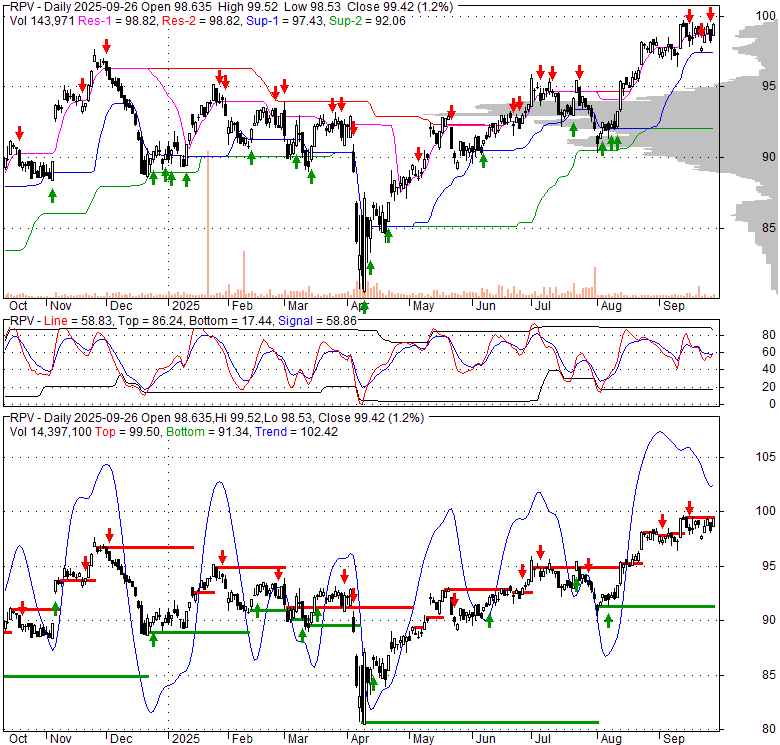
Price has closed below its short-term moving average. Short-term moving average is currently below mid-term; and above long-term moving average. From the relationship between price and moving averages: This stock is BEARISH in short-term; and NEUTRAL in mid-long term.[ RPV ] has closed below upper band by 22.1%. Bollinger Bands are 7.9% narrower than normal. The current width of the bands does not suggest anything about the future direction or movement of prices.
| If tomorrow: | Open lower | Open higher |
| High: | 119.07 - 119.55 | 119.55 - 120.01 |
| Low: | 116.28 - 116.82 | 116.82 - 117.33 |
| Close: | 117.63 - 118.47 | 118.47 - 119.27 |
The Invesco S&P 500 Pure Value ETF, identified by the symbol RPV, is designed to track the performance of the S&P 500 Pure Value Index. This fund is committed to investing a minimum of 90% of its total assets in the underlying securities that make up this index. The index itself aims to capture the returns of companies within the broader S&P 500 universe that prominently display strong "value" characteristics. Its methodology begins by evaluating every security in the S&P 500 and assigning it distinct "style scores" for both value and growth, based on inherent company attributes. The "value score" is derived from three financial ratios: book-value-to-price, earnings-to-price, and sales-to-price. Conversely, the "growth score" considers different factors, such as the three-year growth in sales per share, the three-year ratio of earnings per share change relative to price, and the stock's 12-month price momentum. These individual growth and value scores are then compared (specifically, the growth score divided by the value score) to classify each stock into one of three categories: "deep value," "blend," or "deep growth." Only those stocks designated as "deep value" are ultimately selected for inclusion in the index. Furthermore, these chosen securities are weighted according to their value strength, meaning those with the most compelling value attributes receive a proportionally larger allocation within the index. Both the ETF and its benchmark index undergo a comprehensive rebalancing process on an annual basis.
Tue, 13 Oct 2026
INVESCO EXCHANGE TRADED FD TR S (^RSPT-IV) Latest Stock News & Headlines - Yahoo! Finance Canada
Tue, 13 Oct 2026
INVESCO EXCHANGE TRADED FD TR S (^RSPN-IV) Options Chain - Yahoo! Finance Canada
Mon, 12 Oct 2026
INVESCO EXCHANGE TRADED FD TR S (^RSPN-IV) Interactive Stock Chart - Yahoo! Finance Canada
Sun, 11 Oct 2026
Which Pharmaceuticals ETF Is the Better Buy: iShares’ IHE or Invesco’s PJP? - The Motley Fool
Sun, 11 Oct 2026
Which Healthcare ETF Is the Better Buy: Fidelity’s Broad FHLC or Invesco’s Biotech-Focused PBE? - The Motley Fool
Sat, 10 Oct 2026
Invesco (IVZ) Stock Could Be 39% Undervalued On Excess Returns - Yahoo Finance UK
| Price to Book Value: P/BV, a ratio used to compare book value to its current market price, to gauge whether a stock is valued properly. |
Neutral |
| Price to Earnings: PE, the ratio for valuing a company that measures its current share price relative to its earnings per share (EPS). |
Neutral |
| Discounted cash flow: DCF, a valuation method used to estimate the value of an investment based on its expected future cash flows. |
Neutral |
| Return on Assets: ROA, indicates how profitable a company is in relation to its total assets, how efficiently uses assets to generate a profit. |
Neutral |
| Return on Equity: ROE, a measure of financial performance calculated by dividing net income by equity. a gauge of profitability and efficiency. |
Neutral |
| Debt to Equity: evaluate financial leverage, reflects the ability of equity to cover outstanding debts in the event of a business downturn. |
Neutral |
|
Exchange:
AMEX
|
|
|
Sector:
Financial Services
|
|
|
Industry:
Asset Management - Global
|
|
| Shares Out | 0 (M) |
| Shares Float | 0 (M) |
| Held by Insiders | 0 (%) |
| Held by Institutions | 0 (%) |
| Shares Short | 0 (K) |
| Shares Short P.Month | 0 (K) |
| EPS | 0 |
| EPS Est Next Qtrly | 0 |
| EPS Est This Year | 0 |
| EPS Est Next Year | 0 |
| Book Value (p.s.) | 0 |
| Profit Margin | 0 % |
| Operating Margin | 0 % |
| Return on Assets (ttm) | 0 % |
| Return on Equity (ttm) | 0 % |
| Qtrly Rev. Growth | 0 % |
| Gross Profit (p.s.) | 0 |
| Sales Per Share | 0 |
| EBITDA (p.s.) | 0 |
| Qtrly Earnings Growth | 0 % |
| Operating Cash Flow | 0 (M) |
| Levered Free Cash Flow | 0 (M) |
| PE Ratio | 0 |
| PEG Ratio | 0 |
| Price to Book value | 0 |
| Price to Sales | 0 |
| Price to Cash Flow | 0 |
| Dividend | 0 |
| Forward Dividend | 0 |
| Dividend Yield | 0% |
| Dividend Pay Date | Invalid DateTime. |
| Ex-Dividend Date | Invalid DateTime. |

|

|

|

|
|
|
|
|
|