
| 76.8 -0.18 (-0.23%) | 09-15 15:59 | |||||||||||||
|
|
| Short term |  |
|||
| Mid term | |
|||
| Targets | 6-month : | 91.12  |
1-year : | 92.23 |
| Resists | First : | 78.02 |
Second : | 78.97 |
| Pivot price | 77.31 |
|||
| Supports | First : | 76.48 |
Second : | 63.63 |
| MAs | MA(5) : | 76.95 |
MA(20) : | 77.42 |
| MA(100) : | 74.72  |
MA(250) : | 70.25 |
|
| MACD | MACD : | -0.1 |
Signal : | 0 |
| %K %D | K(14,3) : | 22.4 |
D(3) : | 21.9 |
| RSI | RSI(14): 44.5 |
|||
| 52-week | High : | 78.97 | Low : | 62.34 |
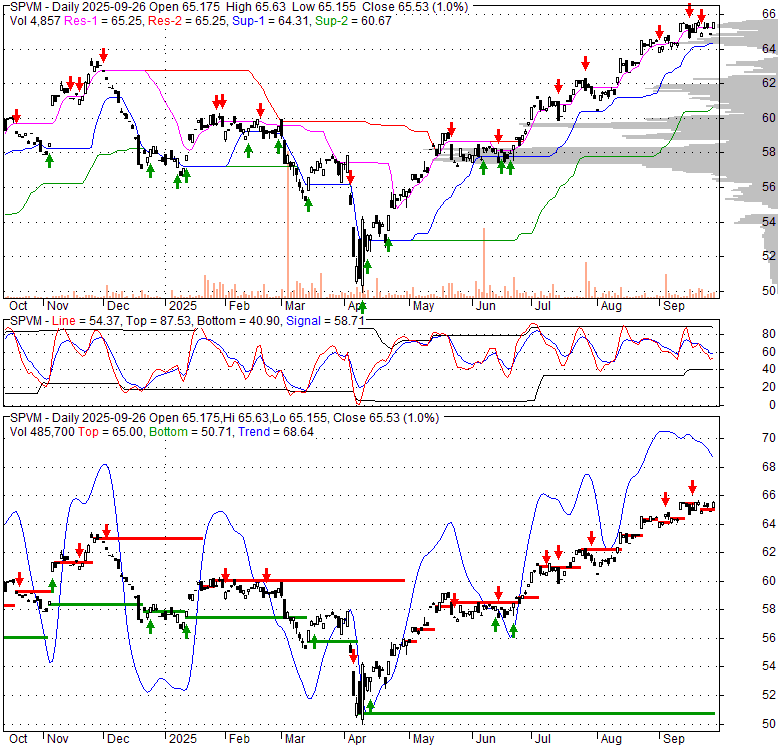
Price has closed below its short-term moving average. Short-term moving average is currently below mid-term; and above long-term moving average. From the relationship between price and moving averages: This stock is BEARISH in short-term; and NEUTRAL in mid-long term.[ SPVM ] has closed above bottom band by 21.6%. Bollinger Bands are 20.2% narrower than normal. The current width of the bands does not suggest anything about the future direction or movement of prices.
| If tomorrow: | Open lower | Open higher |
| High: | 77.13 - 77.57 | 77.57 - 78.05 |
| Low: | 75.24 - 75.73 | 75.73 - 76.27 |
| Close: | 75.87 - 76.73 | 76.73 - 77.66 |
The Invesco S&P 500 Value with Momentum ETF (the Fund) is designed to track the investment results of the S&P 500 High Momentum Value Index (the Index). The Fund aims to invest at least 90% of its total assets in the constituent securities that form this Index. This Index comprises 100 stocks selected from the broader S&P 500 Index. These selections are made using an established methodology that identifies companies with the highest "value scores" and "momentum scores." Once chosen, the individual holdings within the Index are weighted based on their value scores, with companies exhibiting stronger value characteristics receiving a greater proportion of the Index's total weight. Both the Fund and its underlying Index are adjusted and re-evaluated twice a year. Specifically, a company's "value score" is derived from its book-to-price ratio, while its "momentum score" is based on its cumulative return over the past 20 trading days.
Sat, 12 Sep 2026
Invesco (IVZ) Stock Looks Below Fair Value On Returns But Above Fair Value On Sales - simplywall.st
Thu, 10 Sep 2026
Is Invesco Large Cap Growth ETF (PWB) a Strong ETF Right Now? - Yahoo Finance
Wed, 09 Sep 2026
iShares' IYH or Invesco's PBE: Which Healthcare ETF Is the Better Long-Term Buy? - The Motley Fool
Fri, 04 Sep 2026
Invesco (IVZ) Stock Looks Below Fair Value But Above Fair Value On Sales - Yahoo Finance
Wed, 02 Sep 2026
Invesco (IVZ) Stock Looks Like A Bargain On Fair Value Yet Fully Priced On Sales - simplywall.st
Tue, 01 Sep 2026
Invesco S&P 500 Equal Weight ETF (RSP) Reaches $100 Billion AUM Milestone - TradingView
| Price to Book Value: P/BV, a ratio used to compare book value to its current market price, to gauge whether a stock is valued properly. |
Neutral |
| Price to Earnings: PE, the ratio for valuing a company that measures its current share price relative to its earnings per share (EPS). |
Neutral |
| Discounted cash flow: DCF, a valuation method used to estimate the value of an investment based on its expected future cash flows. |
Neutral |
| Return on Assets: ROA, indicates how profitable a company is in relation to its total assets, how efficiently uses assets to generate a profit. |
Neutral |
| Return on Equity: ROE, a measure of financial performance calculated by dividing net income by equity. a gauge of profitability and efficiency. |
Neutral |
| Debt to Equity: evaluate financial leverage, reflects the ability of equity to cover outstanding debts in the event of a business downturn. |
Neutral |
|
Exchange:
AMEX
|
|
|
Sector:
Financial Services
|
|
|
Industry:
Asset Management - Global
|
|
| Shares Out | 0 (M) |
| Shares Float | 0 (M) |
| Held by Insiders | 0 (%) |
| Held by Institutions | 0 (%) |
| Shares Short | 0 (K) |
| Shares Short P.Month | 0 (K) |
| EPS | 0 |
| EPS Est Next Qtrly | 0 |
| EPS Est This Year | 0 |
| EPS Est Next Year | 0 |
| Book Value (p.s.) | 0 |
| Profit Margin | 0 % |
| Operating Margin | 0 % |
| Return on Assets (ttm) | 0 % |
| Return on Equity (ttm) | 0 % |
| Qtrly Rev. Growth | 0 % |
| Gross Profit (p.s.) | 0 |
| Sales Per Share | 0 |
| EBITDA (p.s.) | 0 |
| Qtrly Earnings Growth | 0 % |
| Operating Cash Flow | 0 (M) |
| Levered Free Cash Flow | 0 (M) |
| PE Ratio | 0 |
| PEG Ratio | 0 |
| Price to Book value | 0 |
| Price to Sales | 0 |
| Price to Cash Flow | 0 |
| Dividend | 0 |
| Forward Dividend | 0 |
| Dividend Yield | 0% |
| Dividend Pay Date | Invalid DateTime. |
| Ex-Dividend Date | Invalid DateTime. |

|

|
|

|
|
|
|
|
|