
| 59.3741 -0.585 (-0.98%) | 09-15 16:00 | |||||||||||||
|
|
| Short term |  |
|||
| Mid term |   |
|||
| Targets | 6-month : | 70.72 |
1-year : | 71.59 |
| Resists | First : | 60.55 |
Second : | 61.29 |
| Pivot price | 60.49 |
|||
| Supports | First : | 59.34 |
Second : | 49.37 |
| MAs | MA(5) : | 59.99 |
MA(20) : | 60.35 |
| MA(100) : | 59.36 |
MA(250) : | 57.59  |
|
| MACD | MACD : | 0 |
Signal : | 0.2 |
| %K %D | K(14,3) : | 4.3 |
D(3) : | 14.7 |
| RSI | RSI(14): 38.4 |
|||
| 52-week | High : | 61.29 | Low : | 51.71 |
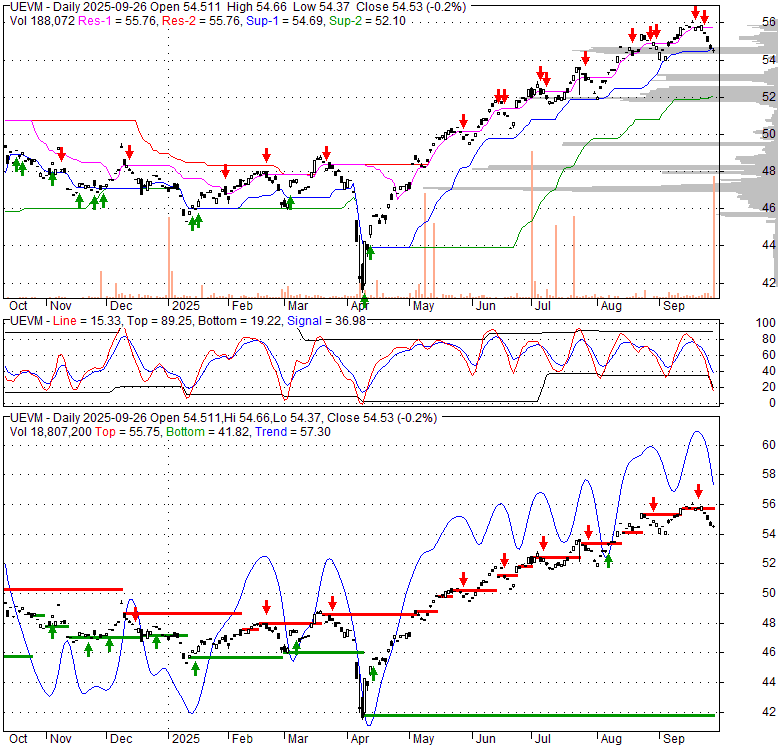
Price has closed below its short-term moving average. Short-term moving average is currently above mid-term; and above long-term moving average. From the relationship between price and moving averages: This stock is NEUTRAL in short-term; and BULLISH in mid-long term.[ UEVM ] has closed below the lower bollinger band by 12.5%. Although price has broken the lower band and a downside breakout is possible; the most likely direction for [ UEVM ] is to continue within current trading range. Bollinger Bands are 32.6% narrower than normal. The current width of the bands does not suggest anything about the future direction or movement of prices.
| If tomorrow: | Open lower | Open higher |
| High: | 59.6 - 59.94 | 59.94 - 60.31 |
| Low: | 58.37 - 58.75 | 58.75 - 59.17 |
| Close: | 58.66 - 59.32 | 59.32 - 60.04 |
The VictoryShares Emerging Markets Value Momentum ETF (UEVM) aims to replicate, before the deduction of fees and expenses, the investment performance of its underlying benchmark, the Nasdaq Victory Emerging Market Value Momentum Index. This index is exclusively made up of shares from companies located in developing economies. These companies are specifically chosen for their pronounced exposure to both value and momentum factors, with the additional goals of achieving more controlled portfolio turnover and exhibiting lower realized volatility when contrasted with typical market-capitalization-weighted indexes. The methodology involves assessing and scoring each stock for its value and momentum attributes, relative to its sector. A combined score is then calculated for every security by giving equal weight to its individual value and momentum scores. Subsequently, the top 25% of these securities are chosen. Their allocation within the index is then optimized by assigning greater proportional influence to those demonstrating historically lower realized volatility. The index undergoes rebalancing adjustments every quarter. To guarantee sufficient tradability, a liquidity filter is applied, excluding less liquid assets by retaining only the top 90% of securities based on their annualized trading volume over the preceding 12 months. The index encompasses a range of equity instruments, including both American Depositary Receipts (ADRs) and Global Depositary Receipts (GDRs).
Tue, 15 Sep 2026
(UEVM) as a Liquidity Pulse for Institutional Tactics - Stock Traders Daily
Fri, 04 Sep 2026
(UEVM) Movement as an Input in Quant Signal Sets - Stock Traders Daily
Sun, 23 Aug 2026
UEVM | VictoryShares Emerging Markets Value Insider Trading - Quiver Quantitative
Fri, 08 May 2026
ETFs Investing in Foxconn Technology Co., Ltd. Stocks - TradingView
Mon, 20 Oct 2025
For Targeted EM Exposure, Consider South Korea ETFs - ETF Trends
Sun, 28 Sep 2025
ETFs Investing in Chery Automobile Co.,Ltd. Class H Stocks - TradingView
| Price to Book Value: P/BV, a ratio used to compare book value to its current market price, to gauge whether a stock is valued properly. |
Neutral |
| Price to Earnings: PE, the ratio for valuing a company that measures its current share price relative to its earnings per share (EPS). |
Neutral |
| Discounted cash flow: DCF, a valuation method used to estimate the value of an investment based on its expected future cash flows. |
Neutral |
| Return on Assets: ROA, indicates how profitable a company is in relation to its total assets, how efficiently uses assets to generate a profit. |
Neutral |
| Return on Equity: ROE, a measure of financial performance calculated by dividing net income by equity. a gauge of profitability and efficiency. |
Neutral |
| Debt to Equity: evaluate financial leverage, reflects the ability of equity to cover outstanding debts in the event of a business downturn. |
Neutral |
|
Exchange:
NASDAQ
|
|
|
Sector:
Financial Services
|
|
|
Industry:
Asset Management - Global
|
|
| Shares Out | 0 (M) |
| Shares Float | 0 (M) |
| Held by Insiders | 0 (%) |
| Held by Institutions | 0 (%) |
| Shares Short | 0 (K) |
| Shares Short P.Month | 0 (K) |
| EPS | 0 |
| EPS Est Next Qtrly | 0 |
| EPS Est This Year | 0 |
| EPS Est Next Year | 0 |
| Book Value (p.s.) | 0 |
| Profit Margin | 0 % |
| Operating Margin | 0 % |
| Return on Assets (ttm) | 0 % |
| Return on Equity (ttm) | 0 % |
| Qtrly Rev. Growth | 0 % |
| Gross Profit (p.s.) | 0 |
| Sales Per Share | 0 |
| EBITDA (p.s.) | 0 |
| Qtrly Earnings Growth | 0 % |
| Operating Cash Flow | 0 (M) |
| Levered Free Cash Flow | 0 (M) |
| PE Ratio | 0 |
| PEG Ratio | 0 |
| Price to Book value | 0 |
| Price to Sales | 0 |
| Price to Cash Flow | 0 |
| Dividend | 0 |
| Forward Dividend | 0 |
| Dividend Yield | 0% |
| Dividend Pay Date | Invalid DateTime. |
| Ex-Dividend Date | Invalid DateTime. |

|

|
|

|
|
|
|
|
|