
| 75.7 0.03 (0.04%) | 09-25 16:00 | |||||||||||||
|
|
| Short term |  |
|||
| Mid term |   |
|||
| Targets | 6-month : | 88.42 |
1-year : | 103.28 |
| Resists | First : | 75.7 |
Second : | 88.42 |
| Pivot price | 75.61 |
|||
| Supports | First : | 75.53 |
Second : | 75.42 |
| MAs | MA(5) : | 75.66 |
MA(20) : | 75.58 |
| MA(100) : | 75.15 |
MA(250) : | 74.34 |
|
| MACD | MACD : | 0 |
Signal : | 0 |
| %K %D | K(14,3) : | 98  |
D(3) : | 99.3 |
| RSI | RSI(14): 96.2 |
|||
| 52-week | High : | 75.7 | Low : | 72.97 |
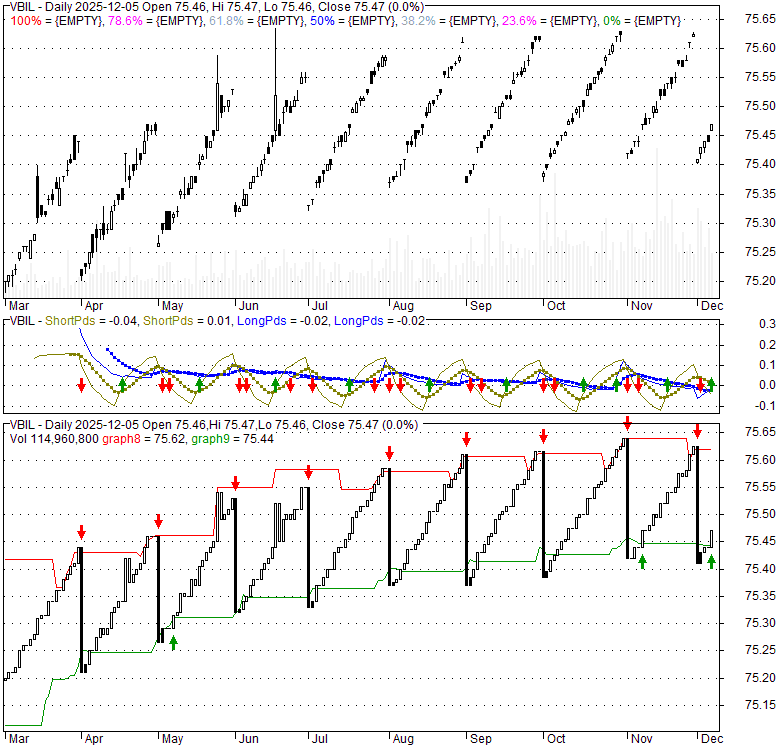
Price has closed above its short-term moving average. Short-term moving average is currently above mid-term; and above long-term moving average. From the relationship between price and moving averages: This stock is BULLISH in short-term; and BULLISH in mid-long term.[ VBIL ] has closed below upper band by 3.8%. Bollinger Bands are 0.7% narrower than normal. The current width of the bands does not suggest anything about the future direction or movement of prices.
| If tomorrow: | Open lower | Open higher |
| High: | 75.78 - 76.15 | 76.15 - 76.46 |
| Low: | 74.78 - 75.21 | 75.21 - 75.59 |
| Close: | 75.06 - 75.72 | 75.72 - 76.3 |
The Vanguard 0-3 Month Treasury Bill ETF (VBIL) aims to replicate the performance of a market-value-weighted Treasury index characterized by a very short dollar-weighted average maturity. This passively managed fund specifically targets the Bloomberg US Treasury Bills 0-3 Months Index. This benchmark consists of U.S. Treasury Bills that mature within three months, deliberately excluding inflation-protected bonds, floating rate securities, and certain other types of debt. Rather than holding every component, VBIL employs a sampling approach, investing in a selection of securities designed to mirror the comprehensive index's risk factors and overall profile. Ordinarily, the fund commits at least 80%—and typically all—of its assets to either the index's constituent securities or to other investments that the advisor deems economically equivalent. To ensure accurate index tracking, the fund may also utilize debt instruments not explicitly part of the index, cash, cash equivalents, or various money market instruments like repurchase agreements and money market funds (including those affiliated with the advisor). A primary objective is to maintain a dollar-weighted average maturity consistent with the index, which is typically less than three months under normal market conditions.
Wed, 23 Sep 2026
Best Performing ETFs: Top Returns at a Glance - TradingKey
Fri, 18 Sep 2026
Vanguard launches T-bill ETF VBIL to rival iSha... - Pluang
Fri, 18 Sep 2026
SGOV vs. VBIL: Vanguard Finally Has a T-Bill ETF, So Is It the Cheaper Place to Park Cash? - Yahoo Finance
Wed, 02 Sep 2026
VBIL: Fixed Income Strategy At The Ultra-Short End Of The Yield Curve (NASDAQ:VBIL) - Seeking Alpha
Thu, 30 Jul 2026
Vanguard Treasury Bill ETF (VBIL) Touches Fresh 52-Week High - Zacks Investment Research
Tue, 07 Jul 2026
Market Valuation, Inflation and Treasury Yields: June 2026 - etfdb.com
| Price to Book Value: P/BV, a ratio used to compare book value to its current market price, to gauge whether a stock is valued properly. |
Neutral |
| Price to Earnings: PE, the ratio for valuing a company that measures its current share price relative to its earnings per share (EPS). |
Neutral |
| Discounted cash flow: DCF, a valuation method used to estimate the value of an investment based on its expected future cash flows. |
Neutral |
| Return on Assets: ROA, indicates how profitable a company is in relation to its total assets, how efficiently uses assets to generate a profit. |
Neutral |
| Return on Equity: ROE, a measure of financial performance calculated by dividing net income by equity. a gauge of profitability and efficiency. |
Neutral |
| Debt to Equity: evaluate financial leverage, reflects the ability of equity to cover outstanding debts in the event of a business downturn. |
Neutral |
|
Exchange:
NASDAQ
|
|
|
Sector:
Financial Services
|
|
|
Industry:
Asset Management - Bonds
|
|
| Shares Out | 0 (M) |
| Shares Float | 0 (M) |
| Held by Insiders | 0 (%) |
| Held by Institutions | 0 (%) |
| Shares Short | 0 (K) |
| Shares Short P.Month | 0 (K) |
| EPS | 0 |
| EPS Est Next Qtrly | 0 |
| EPS Est This Year | 0 |
| EPS Est Next Year | 0 |
| Book Value (p.s.) | 0 |
| Profit Margin | 0 % |
| Operating Margin | 0 % |
| Return on Assets (ttm) | 0 % |
| Return on Equity (ttm) | 0 % |
| Qtrly Rev. Growth | 0 % |
| Gross Profit (p.s.) | 0 |
| Sales Per Share | 0 |
| EBITDA (p.s.) | 0 |
| Qtrly Earnings Growth | 0 % |
| Operating Cash Flow | 0 (M) |
| Levered Free Cash Flow | 0 (M) |
| PE Ratio | 0 |
| PEG Ratio | 0 |
| Price to Book value | 0 |
| Price to Sales | 0 |
| Price to Cash Flow | 0 |
| Dividend | 0 |
| Forward Dividend | 0 |
| Dividend Yield | 0% |
| Dividend Pay Date | Invalid DateTime. |
| Ex-Dividend Date | Invalid DateTime. |

|

|
|

|
|
|
|
|
|