
| 185.62 1.5 (0.81%) | 09-11 16:00 | |||||||||||||
|
|
| Short term |   |
|||
| Mid term | |
|||
| Targets | 6-month : | 217.6 |
1-year : | 219.67 |
| Resists | First : | 186.3 |
Second : | 188.08 |
| Pivot price | 186.18 |
|||
| Supports | First : | 183.43 |
Second : | 152.61 |
| MAs | MA(5) : | 185.63  |
MA(20) : | 186.23 |
| MA(100) : | 177.08 |
MA(250) : | 161.38 |
|
| MACD | MACD : | 0.5 |
Signal : | 0.9 |
| %K %D | K(14,3) : | 27.4 |
D(3) : | 35 |
| RSI | RSI(14): 51.7 |
|||
| 52-week | High : | 188.08 | Low : | 137.6 |
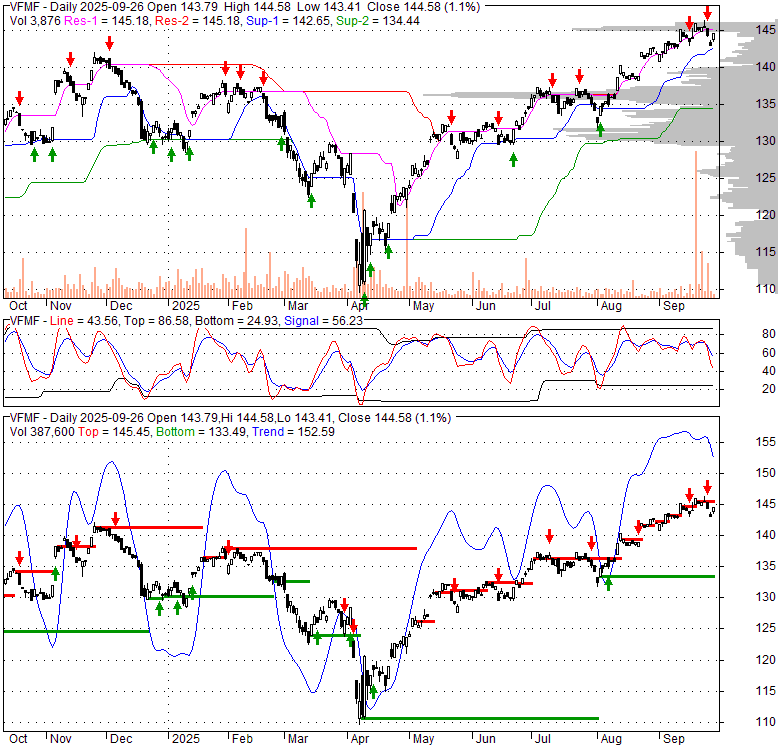
Price has closed below its short-term moving average. Short-term moving average is currently above mid-term; and above long-term moving average. From the relationship between price and moving averages: This stock is NEUTRAL in short-term; and BULLISH in mid-long term.[ VFMF ] has closed above bottom band by 36.9%. Bollinger Bands are 28.8% narrower than normal. The current width of the bands does not suggest anything about the future direction or movement of prices.
| If tomorrow: | Open lower | Open higher |
| High: | 186.44 - 187.68 | 187.68 - 188.79 |
| Low: | 181.52 - 183.12 | 183.12 - 184.57 |
| Close: | 183.17 - 185.67 | 185.67 - 187.93 |
The fund's advisor utilizes a systematic, data-driven quantitative framework to analyze U.S. common stocks, building an equity portfolio specifically designed to capture exposure to various investment factors. The process begins with an initial filter that eliminates the most volatile securities from the investment universe. Subsequently, stocks are selected based on an equally weighted composite score derived from three targeted factors: momentum, which identifies companies demonstrating strong recent price performance; quality, focusing on businesses with robust fundamental health; and value, selecting stocks trading at attractive prices relative to their underlying financial metrics. This approach yields a highly diversified portfolio consisting of hundreds of individual holdings, encompassing a broad range of market capitalizations—including large, mid, and small-cap companies—as well as various economic sectors and distinct industry groups, thereby minimizing stock-specific risks. The portfolio undergoes periodic rebalancing to ensure sustained alignment with its intended factor exposures. The primary investment objective is to achieve long-term capital growth. Generally, a minimum of 80% of the fund's assets will be allocated to equity securities issued by U.S. corporations. Specifically, the Value factor is determined using metrics such as book value-to-price, forward earnings-to-price, and operating cash flows-to-price (for non-financial firms). Momentum is assessed via total returns over the T-12 to T-1 month period and the T-7 to T-1 month period, in addition to the intercept from a one-year regression of stock returns against their regional benchmark. For financial companies, the Quality factor is gauged by return on equity and share issuance, while for non-financial companies, it involves return on equity, gross profitability, changes in net operating assets, and leverage. The initial volatility screen systematically removes the 20% most volatile names within each market capitalization tier and applies this equally across all sectors.
Mon, 24 Aug 2026
VFMF: This Value Fund Is Quietly Chugging Along (BATS:VFMF) - Seeking Alpha
Mon, 24 Aug 2026
Vanguard U.S. Multifactor ETF gains Buy rating for strong risk-adjusted returns and active management. - Pluang
Mon, 17 Aug 2026
VFMF: Value And EPS Growth Acceleration Makes Vanguard's Multifactor ETF Appealing (Ratings Upgrade) - Seeking Alpha
Mon, 17 Aug 2026
Vanguard U.S. Multifactor ETF upgraded to buy o... - Pluang
Fri, 10 Jul 2026
2 Vanguard ETFs Beating the S&P 500 With a Momentum-Driven Strategy - The Motley Fool
Fri, 10 Jul 2026
2 Vanguard ETFs Beating the S&P 500 With a Momentum-Driven Strategy - The Globe and Mail
| Price to Book Value: P/BV, a ratio used to compare book value to its current market price, to gauge whether a stock is valued properly. |
Neutral |
| Price to Earnings: PE, the ratio for valuing a company that measures its current share price relative to its earnings per share (EPS). |
Neutral |
| Discounted cash flow: DCF, a valuation method used to estimate the value of an investment based on its expected future cash flows. |
Neutral |
| Return on Assets: ROA, indicates how profitable a company is in relation to its total assets, how efficiently uses assets to generate a profit. |
Neutral |
| Return on Equity: ROE, a measure of financial performance calculated by dividing net income by equity. a gauge of profitability and efficiency. |
Neutral |
| Debt to Equity: evaluate financial leverage, reflects the ability of equity to cover outstanding debts in the event of a business downturn. |
Neutral |
|
Exchange:
CBOE
|
|
|
Sector:
Financial Services
|
|
|
Industry:
Asset Management - Global
|
|
| Shares Out | 0 (M) |
| Shares Float | 0 (M) |
| Held by Insiders | 0 (%) |
| Held by Institutions | 0 (%) |
| Shares Short | 0 (K) |
| Shares Short P.Month | 0 (K) |
| EPS | 0 |
| EPS Est Next Qtrly | 0 |
| EPS Est This Year | 0 |
| EPS Est Next Year | 0 |
| Book Value (p.s.) | 0 |
| Profit Margin | 0 % |
| Operating Margin | 0 % |
| Return on Assets (ttm) | 0 % |
| Return on Equity (ttm) | 0 % |
| Qtrly Rev. Growth | 0 % |
| Gross Profit (p.s.) | 0 |
| Sales Per Share | 0 |
| EBITDA (p.s.) | 0 |
| Qtrly Earnings Growth | 0 % |
| Operating Cash Flow | 0 (M) |
| Levered Free Cash Flow | 0 (M) |
| PE Ratio | 0 |
| PEG Ratio | 0 |
| Price to Book value | 0 |
| Price to Sales | 0 |
| Price to Cash Flow | 0 |
| Dividend | 0 |
| Forward Dividend | 0 |
| Dividend Yield | 0% |
| Dividend Pay Date | Invalid DateTime. |
| Ex-Dividend Date | Invalid DateTime. |

|

|
|

|
|
|
|
|
|