
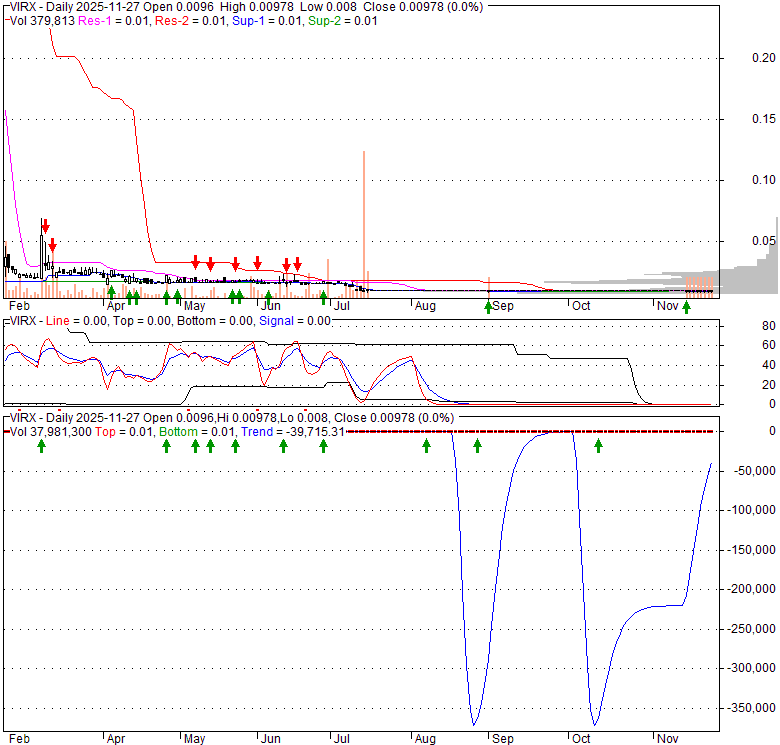
| 0.00978 0 (0%) | 07-02 16:00 | |||||||||||||
|
|
| Short term |  |
|||
| Mid term | |
|||
| Targets | 6-month : | 1-year : | ||
| Resists | First : | Second : | ||
| Pivot price | ||||
| Supports | First : | Second : | ||
| MAs | MA(5) : | MA(20) : | ||
| MA(100) : | MA(250) : | |||
| MACD | MACD : | Signal : | ||
| %K %D | K(14,3) : | D(3) : | ||
| RSI | RSI(14): | |||
| 52-week | High : | Low : | ||
| If tomorrow: | Open lower | Open higher |
| High: | - | - |
| Low: | - | - |
| Close: | - | - |
Viracta Therapeutics, Inc. operates as a precision oncology firm, specializing in the development of therapeutic agents aimed at treating cancers linked to viral infections. The company's leading drug candidate, Nana-val (a combination of nanatinostat and valganciclovir), is currently advancing through multiple clinical trials. It is in Phase II development for Epstein-Barr virus-positive (EBV+) lymphoma. Furthermore, Nana-val is being evaluated in an open-label Phase 2 basket trial, which targets various forms of relapsed/refractory EBV+ lymphoma, and an open-label Phase 1b/2 trial for EBV+ recurrent or metastatic nasopharyngeal carcinoma and other EBV+ solid tumors. Beyond its flagship program, Viracta's pipeline features vecabrutinib, a clinical-stage non-covalent ITK/BTK inhibitor, and VRx-510 (previously known as SNS-510), a PDK-1 inhibitor in its preclinical phase. The company is actively exploring opportunities for development and potential collaborations, particularly for vecabrutinib in conjunction with chimeric antigen receptor (CAR) T-cell therapies, and for VRx-510 across diverse oncological indications. Established in 1998, the company changed its name from Sunesis Pharmaceuticals, Inc. to Viracta Therapeutics, Inc. on February 25, 2021. Its corporate headquarters are located in Cardiff-by-the-Sea, California.
Tue, 03 Sep 2024
Viracta Therapeutics to Present at the H.C. Wainwright 26th Annual Global Investment Conference - GlobeNewswire
Thu, 09 May 2024
VIRX Stock Earnings: Viracta Therapeutics Beats EPS for Q1 2024 - investorplace.com
Mon, 15 Apr 2024
Viracta Therapeutics Announces Positive Topline Nana-val - GlobeNewswire
Sun, 20 Aug 2023
Michael Huang Net Worth (2026) - GuruFocus
Mon, 24 Jul 2023
Viracta Therapeutics: VIRX Stock Price Quote & News - Robinhood
Tue, 04 Apr 2023
William D Unger Net Worth (2026) - GuruFocus
| Price to Book Value: P/BV, a ratio used to compare book value to its current market price, to gauge whether a stock is valued properly. |
Underperform |
| Price to Earnings: PE, the ratio for valuing a company that measures its current share price relative to its earnings per share (EPS). |
Underperform |
| Discounted cash flow: DCF, a valuation method used to estimate the value of an investment based on its expected future cash flows. |
Underperform |
| Return on Assets: ROA, indicates how profitable a company is in relation to its total assets, how efficiently uses assets to generate a profit. |
Underperform |
| Return on Equity: ROE, a measure of financial performance calculated by dividing net income by equity. a gauge of profitability and efficiency. |
Outperform |
| Debt to Equity: evaluate financial leverage, reflects the ability of equity to cover outstanding debts in the event of a business downturn. |
Underperform |
|
Exchange:
OTC
|
|
|
Sector:
Healthcare
|
|
|
Industry:
Biotechnology
|
|
| Shares Out | 0 (M) |
| Shares Float | 0 (M) |
| Held by Insiders | (%) |
| Held by Institutions | (%) |
| Shares Short | 0 (K) |
| Shares Short P.Month | 0 (K) |
| EPS | |
| EPS Est Next Qtrly | |
| EPS Est This Year | |
| EPS Est Next Year | |
| Book Value (p.s.) | |
| Profit Margin | % |
| Operating Margin | % |
| Return on Assets (ttm) | % |
| Return on Equity (ttm) | % |
| Qtrly Rev. Growth | % |
| Gross Profit (p.s.) | |
| Sales Per Share | |
| EBITDA (p.s.) | |
| Qtrly Earnings Growth | % |
| Operating Cash Flow | 0 (M) |
| Levered Free Cash Flow | 0 (M) |
| PE Ratio | |
| PEG Ratio | |
| Price to Book value | |
| Price to Sales | |
| Price to Cash Flow |
| Dividend | |
| Forward Dividend | |
| Dividend Yield | 0% |
| Dividend Pay Date | |
| Ex-Dividend Date |

|

|

|

|
|
|
|
|
|