
| 49.55 0 (0%) | 09-30 16:00 | |||||||||||||
|
|
| Short term |  |
|||
| Mid term |  |
|||
| Targets | 6-month : | 57.91 | 1-year : | 57.97 |
| Resists | First : | 49.58 | Second : | 49.63 |
| Pivot price | 49.54  |
|||
| Supports | First : | 49.49 | Second : | 41.17 |
| MAs | MA(5) : | 49.53  |
MA(20) : | 49.55 |
| MA(100) : | 49.34 |
MA(250) : | 48.83 |
|
| MACD | MACD : | 0 |
Signal : | 0 |
| %K %D | K(14,3) : | 36.3 |
D(3) : | 26.5 |
| RSI | RSI(14): 52.6 | |||
| 52-week | High : | 49.63 | Low : | 47.91 |
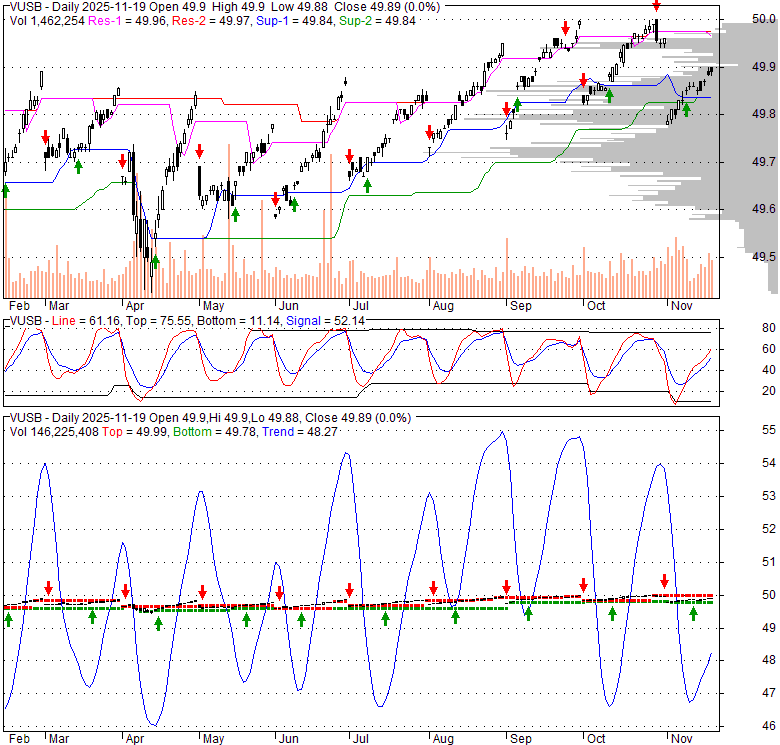
Price has closed above its short-term moving average. Short-term moving average is currently below mid-term; and above long-term moving average. From the relationship between price and moving averages: This stock is NEUTRAL in short-term; and NEUTRAL in mid-long term.[ VUSB ] has closed below upper band by 38.7%. Bollinger Bands are 51.1% narrower than normal. The narrow width of the bands suggests low volatility as compared to its normal range. The bands have been in this narrow range for 0 bars. This is a sign that the market may be about to initiate a new trend.
| If tomorrow: | Open lower | Open higher |
| High: | 49.64 - 49.89 | 49.89 - 50.1 |
| Low: | 48.95 - 49.22 | 49.22 - 49.44 |
| Close: | 49.16 - 49.58 | 49.58 - 49.92 |
This ETF is designed to achieve two primary goals: generating consistent current income for investors while keeping its share price fluctuations to a minimum. It invests predominantly in a diverse portfolio of high-quality fixed income securities, with a smaller portion allocated to those of medium quality. The fund typically maintains a dollar-weighted average maturity ranging from zero to two years. Under normal market conditions, at least 80% of its assets will be dedicated to these debt instruments. The VUSB aims to provide investors with economical access to short-duration, high-quality bonds, including those issued by governments, asset-backed securities, and investment-grade corporations, as well as money market instruments. While it often offers a higher yield than traditional money market funds, it's crucial to understand that its share price will fluctuate. Because this Ultra-Short Bond ETF exposes investors to principal risk, it should not be considered a direct substitute for a money market fund. Furthermore, an upward movement in interest rates can lead to a decrease in the value of the bonds held within the portfolio, subsequently impacting the fund's unit price. It is important to distinguish the Ultra-Short Bond ETF as an independent product, separate from the Vanguard Ultra-Short-Term Bond Fund (VUBFX and VUSFX). Due to differences in their size, specific investment strategies, and underlying holdings, these funds are expected to deliver varying investment returns.
Wed, 30 Sep 2026
Vanguard Ultra-Short Bond ETF declares monthly distribution of $0.1811 - TradingView
Wed, 26 Aug 2026
VUSB: Attractive Short-Term Yield, But A Less Compelling Entry Point (BATS:VUSB) - Seeking Alpha
Tue, 18 Aug 2026
The 5 Safest Vanguard Funds to Own in a Volatile Market - Kiplinger
Wed, 22 Jul 2026
Sell on the Pop Prospects: July 22 Edition - ETF Database
Wed, 15 Jul 2026
Why This Ultra-Short Bond Fund Is Ultra-Popular - The Daily Upside
Tue, 07 Jul 2026
Recent Rumblings From the Fed Could Make This Vanguard Bond ETF a Better Buy - The Motley Fool
| Price to Book Value: P/BV, a ratio used to compare book value to its current market price, to gauge whether a stock is valued properly. |
Neutral |
| Price to Earnings: PE, the ratio for valuing a company that measures its current share price relative to its earnings per share (EPS). |
Neutral |
| Discounted cash flow: DCF, a valuation method used to estimate the value of an investment based on its expected future cash flows. |
Neutral |
| Return on Assets: ROA, indicates how profitable a company is in relation to its total assets, how efficiently uses assets to generate a profit. |
Neutral |
| Return on Equity: ROE, a measure of financial performance calculated by dividing net income by equity. a gauge of profitability and efficiency. |
Neutral |
| Debt to Equity: evaluate financial leverage, reflects the ability of equity to cover outstanding debts in the event of a business downturn. |
Neutral |
|
Exchange:
CBOE
|
|
|
Sector:
Financial Services
|
|
|
Industry:
Asset Management - Bonds
|
|
| Shares Out | 0 (M) |
| Shares Float | 0 (M) |
| Held by Insiders | 0 (%) |
| Held by Institutions | 0 (%) |
| Shares Short | 0 (K) |
| Shares Short P.Month | 0 (K) |
| EPS | 0 |
| EPS Est Next Qtrly | 0 |
| EPS Est This Year | 0 |
| EPS Est Next Year | 0 |
| Book Value (p.s.) | 0 |
| Profit Margin | 0 % |
| Operating Margin | 0 % |
| Return on Assets (ttm) | 0 % |
| Return on Equity (ttm) | 0 % |
| Qtrly Rev. Growth | 0 % |
| Gross Profit (p.s.) | 0 |
| Sales Per Share | 0 |
| EBITDA (p.s.) | 0 |
| Qtrly Earnings Growth | 0 % |
| Operating Cash Flow | 0 (M) |
| Levered Free Cash Flow | 0 (M) |
| PE Ratio | 0 |
| PEG Ratio | 0 |
| Price to Book value | 0 |
| Price to Sales | 0 |
| Price to Cash Flow | 0 |
| Dividend | 0 |
| Forward Dividend | 0 |
| Dividend Yield | 0% |
| Dividend Pay Date | Invalid DateTime. |
| Ex-Dividend Date | Invalid DateTime. |

|

|
|

|
|
|
|
|
|